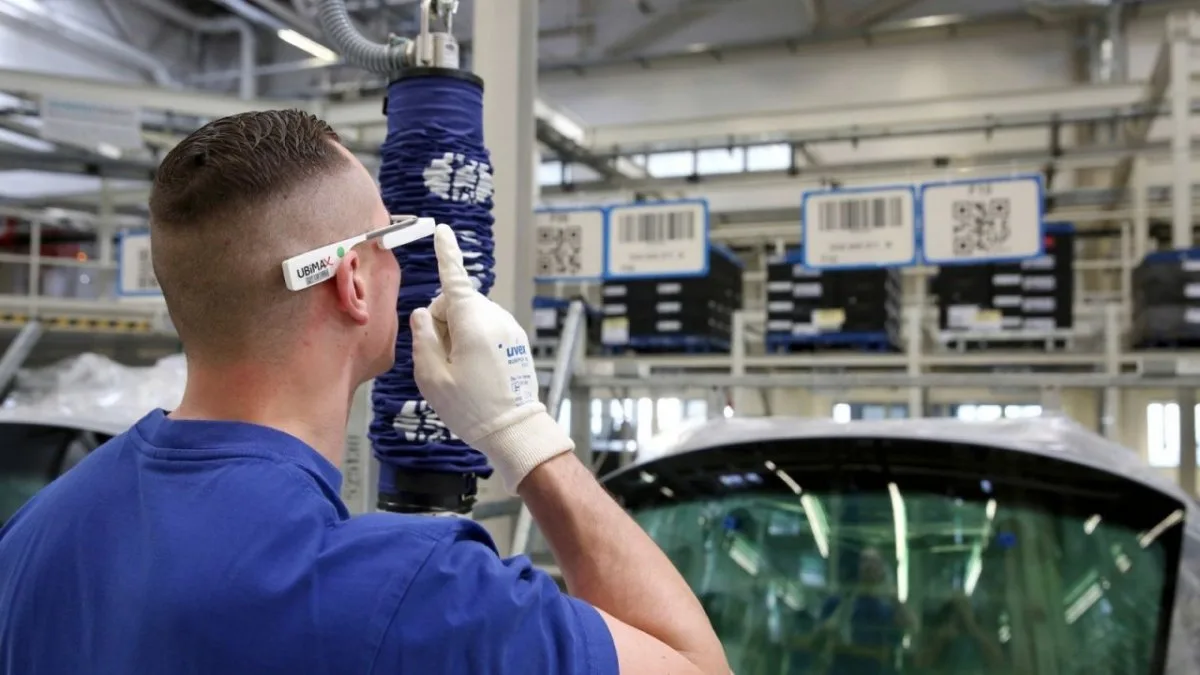
This issue is about practical magic. The technological magic of augmented reality from Upskill, and the mobile-insurance magic of success from Trov. Two startups from different industries, both turning a spectacular technology into a product that actually works.
Startup #1. Upskill augments the reality of the factory floor
Making workers more productive. In the popular imagination, augmented reality is something like the funny stickers in ICQ or Snapchat. But Upskill applies the technology to far more serious matters, improving the productivity of workers in a manufacturing environment.

There are not that many core use cases, but each one is useful to entire industries.
Three scenarios where augmented reality works
- Online instructions. Point Google Glasses or an equivalent device at a barcode, and the glasses can tell you what to do with it and how to proceed.
- Online consultations. A newcomer out in the field can stream what they see to a professional sitting in a comfortable office.
- An online task manager. The next task can literally blink before your eyes, while the place where it has to be done, or any other details you need, can be highlighted somehow.
Why glasses and not a smartphone
Technically, all of this can be done with a mobile phone too, but it does not look as stylish and, more importantly, workers need both hands free. Hence the glasses. Not necessarily Google’s — any similar device will do.
A framework instead of custom development
Obviously, every client’s requirements for products like these are completely unique. So Upskill built something like a framework that makes it possible to implement those requirements quickly.
And it works. Among the satisfied clients is Boeing, for instance, which rolled the glasses out so successfully that it even invested in the startup in the latest round.
The best recommendation a technology product can get is a client who puts money into the project after the rollout.The Startup Review editorial team
Startup #2. The magic of mobile insurance from Trov
A mobile app for insuring your belongings. The startup’s key technical detail is a secret, but the startup itself is so ambitious that it is simply impossible not to write about it.

- Take a photo. The user photographs their electronics and other valuables.
- Describe it. They enter basic information about each item.
- Switch the cover on. After that, a certain amount starts being charged to their card every day.
- Get a repair or the money. If the item breaks or goes missing, it will be repaired or paid for.
The obvious fraud scenarios
The schemes suggest themselves right away:
- Insure an item, sell it and report it missing.
- Insure an item that is already broken.
- Insure an item, switch the cover off, switch it back on when the item breaks and report the damage.
Naturally, Trov does not share the ways it fights all of this — that would make an excellent hint for fraudsters. Instead, Trov talks about “Smart Algorithms Based On Artificial Intelligence”. But the most interesting part is something else: it all works out with perfectly acceptable accuracy.
Proof by contradiction
That is easy to prove: you cannot quietly burn through investors’ money covering fraud. Trov does not do the insuring itself and does not pay out claims — behind the beautiful mobile app stand good old insurance companies, and they clearly would not be sitting on losses. Magic!

Once you accept that, everything else follows logically. In any country there are plenty of people for whom an iPhone is a valuable worth insuring. Trov’s offering is unique both in substance and in interface: clients buy cover, popularity grows, the money comes in.
Geography and money
The startup raised half of that sum in its latest round, a month ago, specifically to fund its entry into several new countries. Trov currently operates in Australia and the United Kingdom and is preparing to move into new markets.
In each country Trov has a single insurance partner, with no marketplaces or auctions. From the user’s point of view, it all looks like working directly with Trov.
In place of a conclusion
The future is arriving. And your startup could bring it closer far faster than Upskill: why settle for small things and augment reality when you could change it?
Write to us with your impressions, share your opinion with our readers and send us links to the startups you would like to see in our next issues. Until the next review!
Texts based on materials from Gornal.