Today's issue takes two steps into the future. In opposite directions, though: one step to the left and welcome to “The Matrix”, Ultrahaptics edition; one step to the right and greetings from Orwell's “1984”, where there is no hiding from the all-seeing eye of Orbital Insight. The jump on the spot we are skipping this time.
Startup No. 1. The pseudo-touch of Ultrahaptics
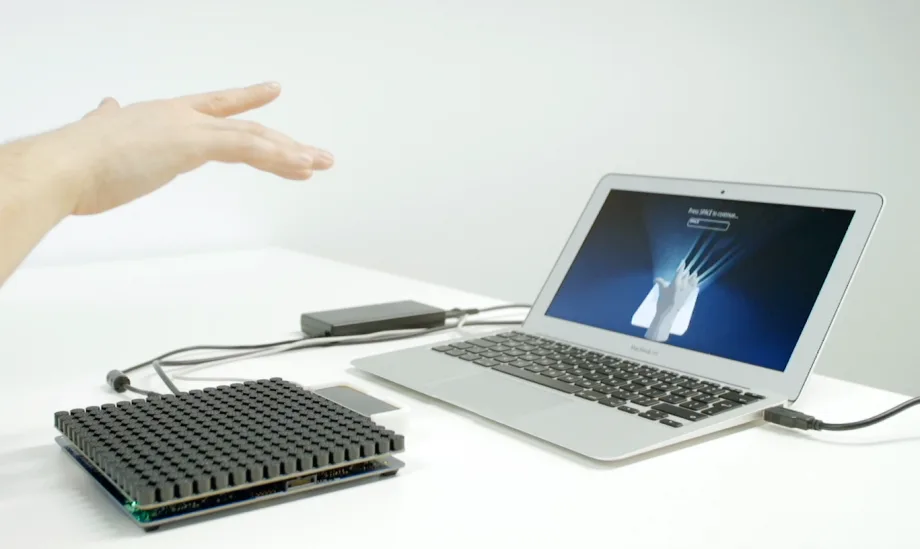
Ultrahaptics is developing a technology that creates tactile sensations. The device is built into some surface, “looks” at the space around it with a camera and, when a hand comes close, generates ultrasonic waves. Correctly chosen waves hitting the palm feel like an ordinary touch — which, in fact, is exactly what it is.
- The device is built into a surface. It can be a panel, a table, any plane next to the user.
- The camera watches the space. The system sees that a hand is approaching and understands exactly where that hand is.
- Ultrasound creates the sensation. The waves are chosen so that the palm feels a touch where physically there is nothing at all.

Where it will genuinely come in handy
In its presentations Ultrahaptics sketches an enormous number of uses for this mechanism — from even more realistic VR games to a new way of interacting with home appliances. But the vast majority of them look less like something in demand and more like something invented on the “because we can” principle.
“Because we can”
More realistic VR games, a new way to control home appliances — there are plenty of scenarios, but most of them demonstrate what the technology is capable of rather than answer a real need.
A pleasant exception
Controlling a car's gadget features: switching the music on or changing the track and similar things, without taking your eyes off the road.
Ordinary physical switches are limited — you cannot fit too many of them, while a touchscreen, which wins in every other area, demands that you look at it, and in a car that is precisely a bad idea. There are voice commands, of course, but why not try an artificial sense of touch as well: no need to be distracted from the road, and no limits on the variety of controls. The future may well look like this too.

What already exists today
Physical devices already exist, but so far only in small numbers, and they are sold to potential developers of applied products for wild amounts of money. There are also partnership contracts with car manufacturers — some of them have already decided to test virtual touch. Over the 3 years of its life Ultrahaptics has raised around 40 million dollars in investment, more than half of it in the latest round, which took place literally days ago.
Startup No. 2. The all-seeing eye of Orbital Insight
Secret surveillance of everyone and everything by satellite has long been a byword, and not only among conspiracy theorists. You can argue about the scale, but the technology makes it possible — that is a fact. And Orbital Insight decided to turn that fact into profit.
The lines of an old song about how everything is visible from above could serve as the company's anthem. Satellites now regularly photograph the entire planet at a fairly high resolution, access to that data is relatively inexpensive — and the idea behind the project is that these images contain a great deal of interesting information that is hard to obtain any other way.

Car parks that tell you about revenue
Owners of retail chains, for example, would be very glad to know:
- how their competitors' various locations are doing;
- which district is worth building in themselves;
- where the situation is so weak that even a single shopping centre cannot carry it on its own.
It cannot be said that nobody knew any of this before — there are plenty of ways to find everything out “on the ground”. But now Orbital Insight produces analytics with far greater accuracy and in a far simpler form for the consumers of the service. From a satellite photo it counts the cars in the car parks of every American shopping centre, then a little magic — adjustments for the time, the day of the week, the weather, something else — and the answer is ready. Attractive charts, reports, any breakdown you like — just pay the money.
Not only shopping centres
Naturally, car parks and shopping centres are not the only useful information that can be extracted from satellites. Another example of an Orbital Insight product is an assessment of how full the world's oil storage facilities are: can you imagine how such data, for all its approximation, can help traders? Or simply an assessment of how the prosperity of cities and regions is changing: in developed countries there is a multitude of different metrics for that, but in many places in Africa there is nothing better than counting new houses and cars from photographs.
Shopping centre car parks
Counting cars in the images plus adjustments for the time, the day of the week and the weather — and the chain's owner sees how the competition is doing.
Oil storage
An assessment of how full the world's storage facilities are. Even approximate figures are a valuable hint for traders.
Cities and regions over time
Where the usual metrics simply do not exist, new houses and cars in the images become the best available indicator.
Custom projects
Besides ready-made reports, the company is happy to carry out a separate study for a client — and the model stays with the company afterwards.
That is exactly the calculation: the models can be reused many times over to sell to new clients — the more of them there are, the greater the revenue and the wider the lead over potential competitors. Over the 4 years of its life the startup has raised 80 million dollars in investment, 50 of them in the latest round, in May of this year.
The two startups side by side
| Startup | What it sells | To whom |
|---|---|---|
| Ultrahaptics | Tactile sensations created by ultrasound without any contact with a surface | Developers of applied products, car manufacturers |
| Orbital Insight | Analytics and reports assembled from satellite imagery | Retail chains, traders, anyone who needs data about regions |
Instead of a conclusion
One startup is teaching machines to touch a person, the other is teaching business to look at the world from above. Both live on investment and both sell a possibility rather than a finished mass-market product. And still, simulating a touch is already as old as “The Matrix”, whereas touching the future is far more interesting.
Have an idea? Come to us — we will build it. Applied futurology by Aniart is simple: we create the future together.The Aniart editorial team
Write to us with your impressions, share your thoughts with our readers and send us links to the startups you would like to see in our issues. See you in the next review!
Texts based on materials from facebook.com/gornal.