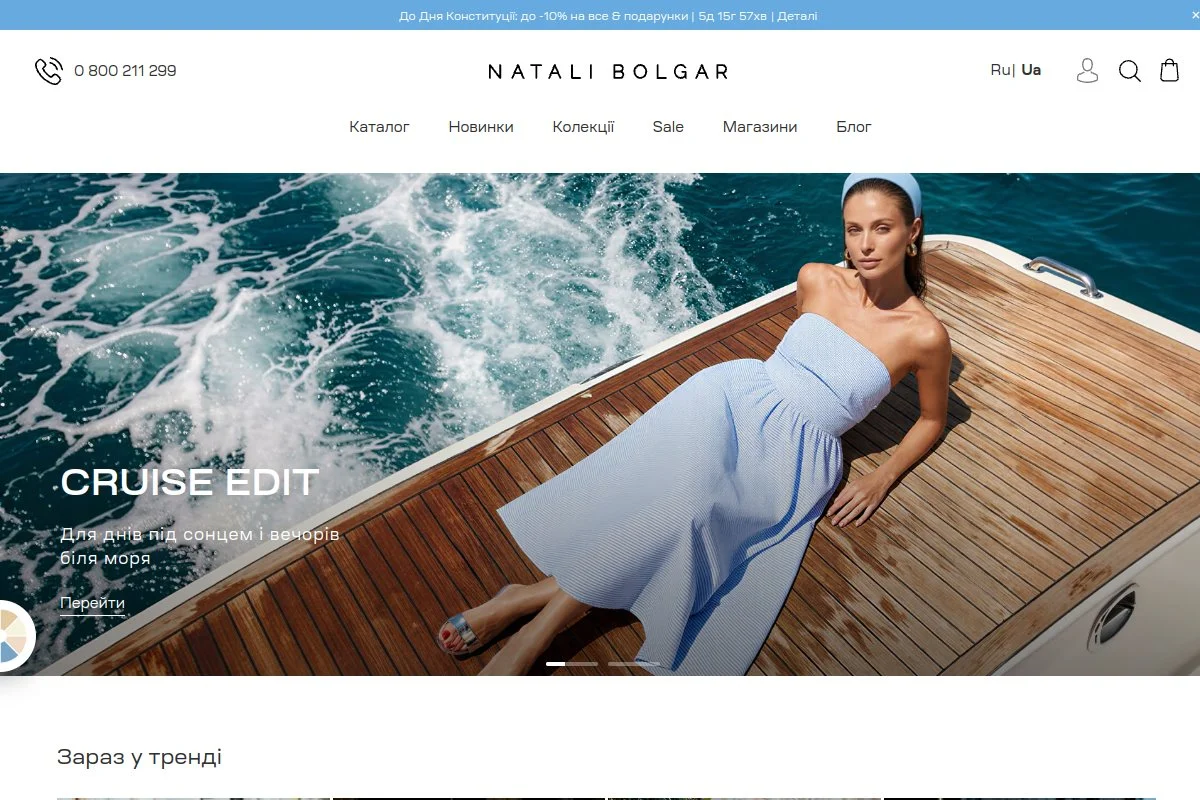

ANIART has been the technical partner of NATALI BOLGAR since 2019. Over that time we moved the store onto a more powerful server core, fixed the places where the business was losing money, and built a working rhythm in which changes ship at the tempo of the brand's collections. In our own development we use AI tools — but inside a controlled process, where the decisions and the responsibility stay with the engineer. Below are the concrete problems we worked on and what solving them gave the business.
Context: a brand that lives by collections
NATALI BOLGAR is a recognizable Ukrainian womenswear brand with its own production cycle and a chain of boutiques. A business like this lives by collections: a new season, new capsules, regular storefront updates. Here the online store is not a business card — it is a full sales channel alongside the boutiques.
And that is the catch: the brand creates its own traffic peaks. A campaign to the customer base, the start of a sale, a new collection announcement — and within minutes hundreds of people are on the site at once. Those are exactly the minutes when the store has to be flawless, because that traffic does not come back for a second chance.
Where we started: where the business was losing
When we took on the infrastructure side, the picture was this: the store worked, but it stumbled precisely where the brand earns. We framed the problems not in technical terms, but in what they cost the business.
| Problem | What it cost the business |
|---|---|
| The store began to stall once a few hundred visitors were on it at once | The most expensive traffic — from campaigns and sales — never reached checkout |
| Slow transition from the catalog into a product page | The customer gave up on the collection and left for a competitor |
| Incomplete delivery data reached the CRM | Managers corrected addresses by hand: slower processing, more room for error |
| The brand could not see task status in real time | Approvals dragged on and fixes shipped later than the collection itself |
How we solved it
1. Migration to a more powerful core — without losing sales
The root of the slowdowns was neither the content nor the design, but capacity: the store simply did not have enough throughput. We planned the move onto a new server with a newer core — carried over every existing customization, reconciled the code against the differences between core versions, fixed compatibility conflicts and load-tested the store in advance.
We agreed the maintenance window with the brand's sales team rather than with ourselves: a weekend morning, when both traffic and revenue are at their lowest. And crucially, we had a rollback plan ready. When the first attempt showed the catalog and checkout behaving differently than they had in testing, we did not start patching things on the live site: we returned the store to the working version, redistributed the server resources, ran the load tests again — and went into the migration a second time, this time with a predictable outcome.
The brand felt the difference immediately. Where the store used to start stalling at 200+ concurrent visitors, it comfortably handled 370+ on the day of a mass campaign — and that was the day with the highest order intake to date. Customers no longer wait for a page to assemble: they browse the catalog, search and buy.
2. Orders that arrive in the CRM ready to process
Speed is only half the job; the other half is what happens after the "Place order" button. We went through the CRM integration and found where the business was losing time: the delivery city and branch were passed in a format the delivery service did not expect — a short name instead of the full one with the region — so a manager had to confirm the address manually.
We wired up the correct city and branch identifiers so that an order from the site lands in the CRM complete. The effect on the business is direct: the manager processes the order straight away instead of finishing it, there are fewer mistakes in shipments and fewer returns caused by a wrong address.
3. Changes at the tempo of collections, not of email threads
When a brand launches a season, a small storefront fix is needed today, not "once a developer frees up". So the brand would not have to hold statuses in their head or wait for reports, we set up notifications from our task system into Telegram: a new task, a new comment, a move into the "in production" status — everything arrives in the messenger with a link to the task.
The result is simple and very practical: approvals stopped dragging on, and urgent fixes ship the same day. The brand sees progress in real time and can plan launches on facts.
AI inside our development
ANIART is a studio that has actually adopted AI in its own work, not just talked about it. On this project that means something concrete: our developers build with Claude Code — the integration layer and the store's ongoing development, for example — and do it faster than was previously possible. We even separately provided the engineer with extended access to AI tools so he would not hit limits in the middle of the project.
But we never put speed above control. For a store that brings in money every day, what matters is not who wrote the code, but who is accountable for it and what happens if something goes wrong.
- An isolated dev environment. All development and experimentation happens on a separate dev copy of the store — the live site stays untouched.
- Development with Claude Code. Our engineer uses AI to write code faster, get to the bottom of tricky areas and take on bigger tasks.
- Engineer review. Every change is reviewed and accepted by our developer — AI speeds the work up, but the responsibility stays with a person.
- Human-gated deploys. Changes reach production only after the engineer decides — nothing ships automatically.
- Backups and monitoring. We keep backups and stability monitoring on our side, so any change can be rolled back safely.
What this gives the business
Traffic reaches checkout
Money spent on a campaign or on ads does not burn up on a slow page — the customer calmly browses the catalog and places the order.
Peak days work for the brand
The store holds up through a sale launch or a new collection drop — exactly when every minute is worth the most.
Less manual work
Orders arrive in the CRM complete, so managers process them instead of repairing delivery data.
Customers come back
An account area with order history and a bonus program drive repeat purchases — the cheapest sale a brand can make.
Faster changes for the same budget
AI in our development means more delivered within the budget: complex tasks stop being a "someday" item.
Peace of mind
Backups, monitoring and support on our side — any change can be rolled back, and a failure spotted before the customer sees it.
What we do for the brand day to day
- Grow the storefront: new sections and features for the brand's current needs.
- Maintain the account area and the bonus program that bring customers back.
- Keep the integrations running — payments, the CRM link and email marketing.
- Watch speed and stability through the sale season.
- Close technical SEO work: correct page addresses, redirects, crawl errors.
- Respond to incidents: certificates, availability, server load.
Architecture and technology
The store runs on a PHP and MySQL stack with a CRM integration, online payments and Cloudflare. In development we use Claude Code, and all the work happens in an isolated dev environment with engineer review, human-gated deploys, backups and stability monitoring. It is the engineering minimum that lets us move fast without risking a live store.
Result
A years-long partnership in which the online channel grows together with the brand: the store has been moved onto a more powerful core and prepared for peak loads, orders reach the CRM complete, and changes ship at the tempo of the collections. AI tools in our development let us take on harder tasks faster — without extra risk to a store that is trading. The NATALI BOLGAR team specifically highlights the communication quality and proactivity of our project manager.
Looking for a technical partner who grows e-commerce fast and with AI — but without risking a live store? Browse our other projects or get in touch.