What could be harder than selling eyewear online? In an online store you cannot try the product on — you cannot see whether the frame shape suits you or whether the lenses have been chosen correctly. As it turns out, optics can be sold just as well as any item of clothing. We proved it while working on the Luxoptica project: the company came to us for help with updating its website.
After all, it is very often the awkward navigation of an online store and the inability to place an order online that cause a business to lose its customers.
About the client
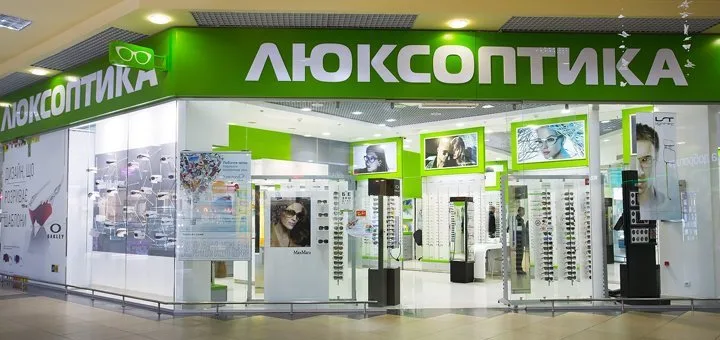
Luxoptica is the largest optical retail chain in the country, with 186 stores across Ukraine, 365 specialists in various fields of ophthalmology, and 3000 own-brand product items.
At that scale it is critical to synchronise the offline and online sales channels and to make a fast, comfortable online purchase possible in any city.
Thanks to the efforts of the Aniart team, the company completed the tasks without which the Luxoptica business could not have developed any further.
Task No. 1. Full ERP integration: synchronising stock levels and orders
In early 2018 Luxoptica found that its online store — the company's main online sales channel — no longer matched the demands of the market or the needs of the business.
- The previous implementation of the project made it impossible to structure the information the site received from the accounting system.
- The Luxoptica team had to work across several separate workspaces. That meant a large amount of manual work, information falling out of sync, and difficulty making changes to the database.
- As a result, customers had no access to up-to-date information on the site.
- The company could not scale the project, even though its growth rate already required it.
- Even a modest flow of customers — up to 100 concurrent users — pushed the site into an unstable state. That made completing a purchase harder and increased the bounce rate.
Given the steady growth of the online sales channel, we faced the task of building a high-quality online resource that could scale with the project and increase sales. To shape the architecture of the new project, we had to study the problems of the existing resource in detail and define the scenarios of user behaviour.
The key task during development was to show the customer a list of products with the current stock levels for every retail location at a specific moment in time, taking the user's location into account as well. Everything would have been fine but for one catch. A single product could contain up to 2600 trade offers, and the price for some items was dynamic — it depended on the number of units added to the cart. Based on a calculation of the stock levels of all the trade offers in the cart, we showed the customer the available delivery options at the checkout stage, which helped optimise logistics costs for our client.Yuliia Plashenko, project manager at Aniart
Task No. 2. Update the site and the project architecture, ensuring stable operation under heavy load
Growing online sales and improving the user experience were the main reasons that prompted Luxoptica to update the site and its architecture.
The ANIART team reworked the project architecture, creating four separate product catalogues and eliminating the duplication of properties for a large number of trade offers.
We wrote about peak loads and architecture testing for the INTERTOP online store in the case study "How to carry successful offline practices over into online. Integrating an online store with ERP and CRM".
Task No. 3. Build a filtering system based on marketing properties
We tied all the information shown to a user to their location. Because of the specific nature of its product, the Luxoptica business is concentrated largely on offline sales, so we worked out the functionality for determining the location of every user on the site.

This made it possible to display up-to-date stock information, to offer a particular customer the addresses of the nearest optical stores that had the product they needed, and to group delivery options according to the set of items in the cart and the city the order had to be shipped to.
User location
Functionality that determines the city a person is visiting the site from. Everything they see next depends on it.
Live stock levels
The quantity of a product at each retail location at a specific moment in time, rather than "across the chain overall".
Nearest optical stores
The customer is offered the addresses of the stores where the product they need is in stock right now.
Delivery grouping
The available delivery options are assembled with the set of items in the cart and the order's city in mind.

Just a few clicks — and the customer sees the product range at the optical store nearest to them.

Communication with the client
The success of every project depends to a great extent on the quality of communication between the product owner and the development team. In the case of the Luxoptica project, the client was fully involved in the work and set out clear business requirements from the very start. Luxoptica supported the development team at every stage.
- Analysis. In the first stage we carried out a deep analysis of the company's previous site — which allowed us to define the development tasks that followed.
- Acceptance criteria. Based on the information gathered, we formulated the main acceptance criteria for the core functionality.
- Sprints. The entire development stage was broken down into sprints, which made collaboration within the team easier.
- A review every iteration. Together with the Luxoptica team, we reviewed the results of the preceding period at every iteration.
Reducing every risk to zero is hard, but this approach let us minimise them as far as possible amid constant change.
Results
Over the course of our work on the Luxoptica project we managed to:
- synchronise the site correctly with the enterprise resource planning (ERP) system;
- set up the data exchange process with the accounting system;
- make the online resource run stably under heavy load;
- set up personalisation for users based on their location.
The Luxoptica project was a genuinely interesting one and, at the same time, a difficult one from the point of view of the architectural solution. Our team had to deliver the expectations clearly described in the documentation under rapidly changing circumstances. Thanks to the coordinated work of the development team, close communication with the client at every level of management and with the team responsible for the accounting system, we were able to achieve a worthy result and laid a solid foundation for scaling the project further.Yuliia Plashenko, project manager at Aniart
ANIART specialises in developing large e-commerce projects and ENTERPRISE solutions. Have a project in mind? We are ready to discuss it with you.