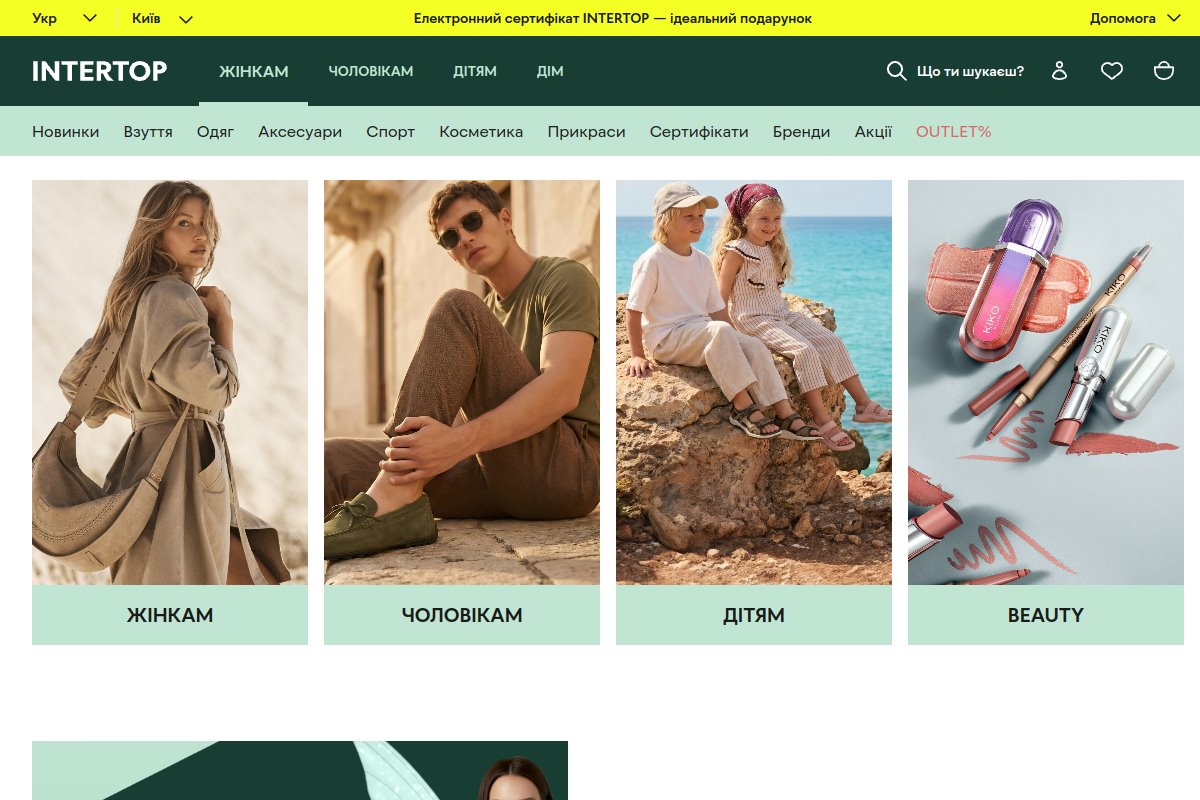
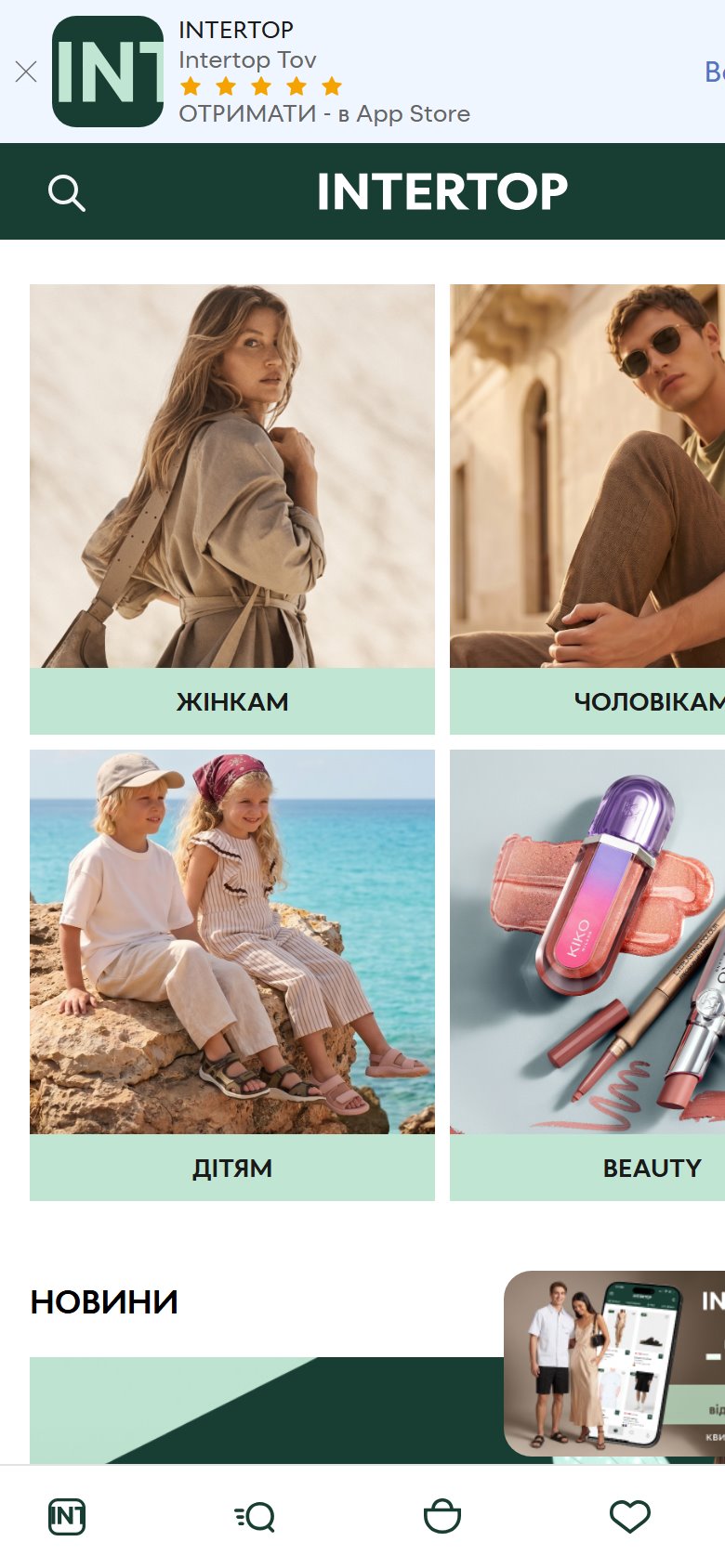
INTERTOP is the largest footwear retailer in Ukraine and Kazakhstan, a brand trading since 1994. We turned its showcase website into an omnichannel footwear e-commerce platform, where the online store and 200+ physical shops work as one system: a shared catalog, real-time stock, a single loyalty card, and in-store reservation of any item at the nearest shop.
Ukraine's largest footwear chain
INTERTOP has been building footwear retail since 1994 and is part of the MTI group. Over 200 stores across Ukraine and Kazakhstan, dozens of global brands on the shelves, millions of customers in the database — this is the scale at which any inaccuracy in the data costs money, and a few minutes of site downtime during a sale is noticed instantly by thousands of people.
A partnership that began in 2014
We have worked with INTERTOP since 2014. Back then the task was framed modestly — to "revive" the website. In reality it was about changing the role of the online channel across the whole business: turning a reference showcase, where people only came to browse the range, into a full-fledged sales channel able to withstand seasonal peaks and grow together with the chain. It was on this foundation that INTERTOP's own marketplace later grew, but it all started with a basic yet fundamental transformation — teaching the site to sell.
The challenge: when online and offline live apart
Before the project began, online and offline existed in parallel. The site displayed the range, but buying on it was difficult, availability data was updated manually and quickly went stale, and the loyalty program worked only in physical stores. A customer who spotted a pair on the site could neither confirm it was in their city, nor reserve it, nor pay by card online.
A 20,000-item catalog in real time
The first release had to cover a catalog of more than 20,000 items — with photos (up to 10 per product) and filters by brand, color and size. But the point was not the volume, it was accuracy: sizes and stock change by the minute across two hundred stores at once. Showing a customer an item that physically isn't there is worse than showing nothing. That is why stock synchronization was a critical requirement from day one.
The gap between the store and the site
The second part of the challenge was behavioral. People are used to buying shoes after trying them on. So the site had to not replace the store but merge with it seamlessly: let customers check availability at a specific location, set a pair aside and collect it after fitting, and earn and spend bonuses regardless of where the purchase happens.
| Dimension | Showcase site (before 2014) | Omnichannel platform |
|---|---|---|
| Role of the channel | A catalog to browse | A full-fledged sales channel |
| Product availability | Manual updates, data went stale | Real-time stock sync with the ERP |
| Placing an order | Mostly a call to a manager | Online order, reserve, pickup, delivery |
| Loyalty program | In physical stores only | A single INTERTOP PLUS card, online and offline |
| Payment | Mostly cash on delivery | Online card payment, acquiring with a 5% discount |
| Logistics | Not automated | Nova Poshta, delivery to any store in the chain |
Approach: first release in three months
We deliberately rejected the idea of "building everything at once." We agreed on a minimal but working first release and launched it in three months — essentially assembling the plane while already in flight. From there we worked in short iterations with regular demos for the INTERTOP team, adding functionality each time based on real customer behavior rather than assumptions.
- A fast first release. Catalog, cart, simplified checkout and ERP integration — the minimum that already sells.
- Loyalty integration. We connected the single INTERTOP PLUS card so bonuses work both online and offline.
- Omnichannel scenarios. Availability checks, reserve and pickup, delivery to any store in the chain.
- Promo engine. Complex campaigns and several discount types that previously lived only offline.
- Load optimization. Cluster, caching and load tests aimed at peak sales.
What we built
Omnichannel
At the core of the platform are the scenarios that stitch online and offline into a single experience:
In-store availability
The customer sees which stores have the size they need before leaving home.
Reserve and pickup
A pair can be set aside online, tried on in store and collected with no prepayment.
Delivery anywhere
Orders are collected at a convenient store in the chain or by Nova Poshta courier.
SMS notifications
Reservation reminders and order statuses reach the customer automatically.
A single loyalty program
The INTERTOP PLUS card stopped being "offline only." We integrated it with the CRM so that purchase history, customer status and the bonus balance are unified across all channels. Now points earned in a store can be spent online — and vice versa. This removed the main barrier between the two worlds and turned loyalty into an end-to-end mechanism.
A promo engine with layered discounts
The hardest part was the discount system. Offline, marketers were used to flexible campaigns, and the site had to reproduce that flexibility. We implemented support for four discount types that can apply at the same time:
- bonus points from the loyalty card;
- gift coupons and promo codes;
- a 5% discount for paying online by card (acquiring);
- individual discounts on specific products and collections.
Architecture and technology
The platform is built on a PHP, MySQL, Redis, Nginx and Docker stack. At its base is a cluster architecture with load balancing: during seasonal sales traffic grows two to five times over, and the system must hold such spikes without degradation. The admin panel is moved to a separate server so that content managers' work doesn't compete for resources with shoppers. Redis caches heavy queries, which lets a page render in under 0.3 seconds even at peak.
The heart of the integration is a two-way exchange with the ERP system: catalog, prices, stock and orders are synchronized in real time, while the CRM holds a single customer profile. Logistics is handled by Nova Poshta with automatic waybill assignment, payment by card acquiring, and communication by an SMS gateway.
Delivery in numbers
Behind the outward simplicity was systematic work: color-coded task tracking, thorough documentation and release discipline. Here is what the scope looked like over 14 months:
| Metric | Value |
|---|---|
| First release | 3 months |
| Active development phase | 7 months |
| Total duration | 14+ months |
| Active-phase team | 7 developers |
| Post-launch support | 2 developers + 3 specialists |
| Tasks completed | 2,400+ |
| Average time per task | 11.5 days |
| Average defect fix | 8.4 hours |
| User documentation | 389 pages |
First-year results
Within the very first year of the renewed platform, the key business metrics changed dramatically:
Two facts were especially telling. About 40% of online orders were placed as reserve and in-store pickup — meaning the omnichannel scenarios genuinely changed customer behavior. And as early as the first month, 25% of purchases were made with a loyalty card, confirming that the single loyalty program worked from the start.
Omnichannel is a step into the future of retail!Oleksii Sapunkov, Head of E-commerce, MTI
INTERTOP has been our partner for over ten years — from the first showcase site to an omnichannel platform and a marketplace. If you run a retail business and want online and offline to work as a single whole, tell us about your project on our contacts page, or browse our other projects.