Life is getting harder for the giants of the new economy: the market is gradually but steadily being taken over by narrowly specialised projects. CooverBox is exactly that kind of example: gift packaging made from designer materials, assembled by hand, produced in small runs, with an individual approach to every order. Here is how we built an online packaging configurator for this brand and connected the website to its accounting system and CRM.
A niche project as an answer to the new economy
Marketers call such projects "niche": they make specialised products and specific services aimed at a narrow audience. 66% of socialmediaexaminer experts consider narrowly specialised projects viable and promising in conditions of fierce competition and permanent crisis: it is precisely their narrow specialisation that turns them into "pros" in their field and lets them confidently play the role of a strong player in a particular industry.
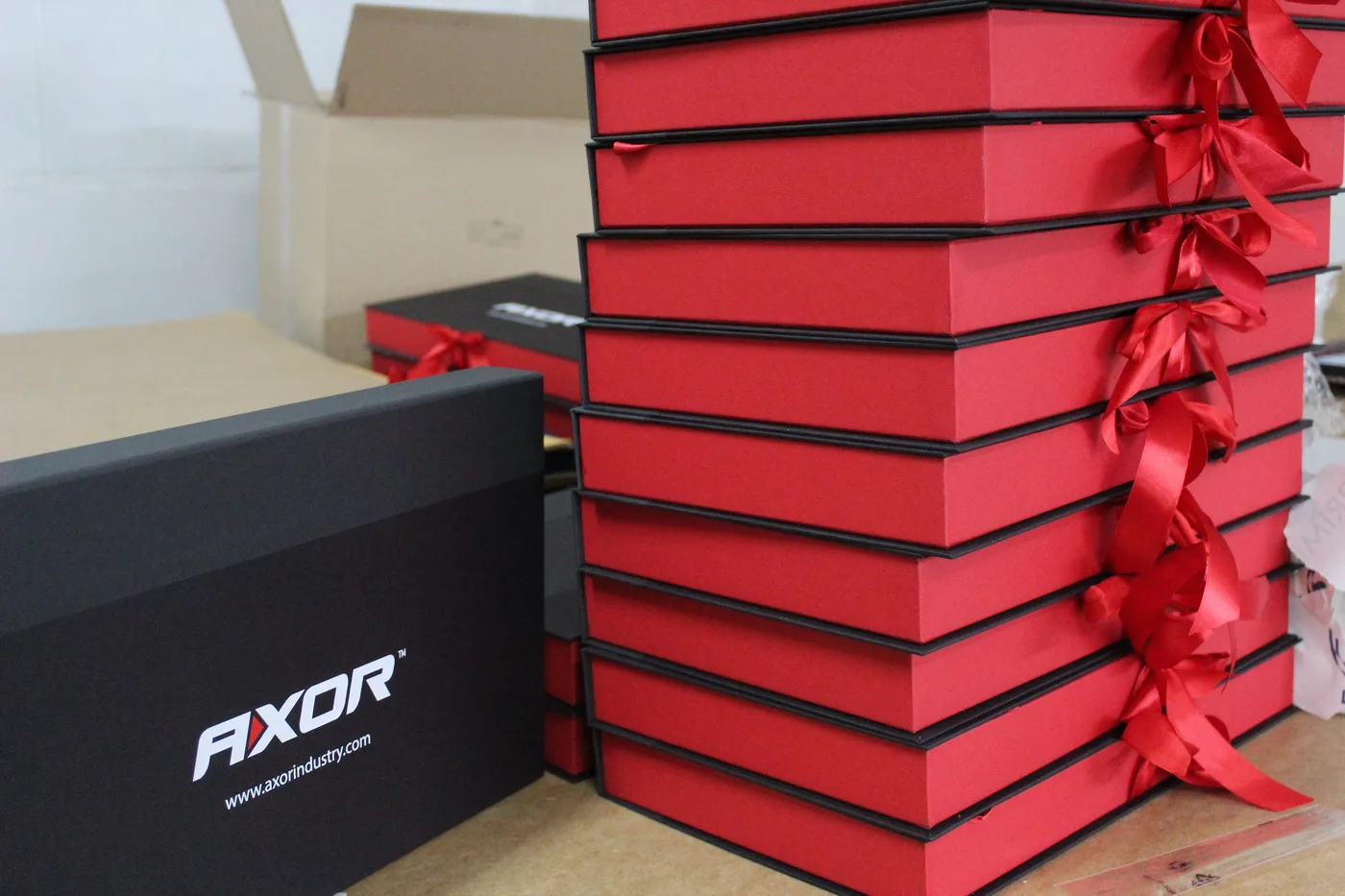
CooverBox is a successful example of a niche company. It is a project that creates gift packaging from designer materials: a wide range of specially developed formats, hand assembly, collaboration with well-known brands and an individual approach. All of this makes the company an interesting and competitive project that has claimed its own place in the market. On top of that, it is an exclusively Ukrainian brand — it is developed and grown by our own specialists from Kyiv and Dnipro.
In the niche we moved into there are no worthy equivalents, so right now we are in the middle of building an ideal and genuinely niche business model. We want to learn how to produce small runs of our products for the needs of a specific client — and at the same time both make money and offer a good price.Artem Shyshkin / founder of the company
The advantages of narrow specialisation
One of the main advantages of niche players is a high level of expertise. Niche companies are often far more aware of business realities, and therefore more agile and quicker to adapt to the constant changes dictated by the age of high technology. In addition, such projects almost always involve an individual approach to each particular client.
- Niche projects are easier to promote and administer — this is a simpler task both in terms of promoting the resource in search engines and in terms of building a marketing campaign in general, since a narrowly specialised project gives a clear picture of the audience it is aimed at and how to reach it.
- Creating niche projects reduces the risk of failure. It is much harder for a broadly focused project to win its place in the sun in a highly competitive environment where experienced companies have long been at work. A niche project substantially reduces that risk — especially when it comes to a pioneer.
- A niche project has an advantage in the client's eyes. Most potential customers looking for a particular service or product will choose a narrowly specialised project, because it looks like the expert to them.

From marketer to his own production
Artem Shyshkin spent a long time working as a marketer in the corporate sector, then left it all behind and decided to start his own business, which at first brought in a very modest income. Fairly quickly, however, the situation changed and turned into steady growth, and the team expanded from 3 to 30 people.
Artem also notes that right now the Ukrainian market is an extremely favourable place for growing startups, since a great many old companies have simply left it, making way for new ventures that adapt quickly to contemporary trends. CooverBox faced that same challenge.
At first, though, nothing was simple. Processing a single order took about two weeks and roughly 30 emails, which slowed the standard order-handling business process down many times over and significantly affected the company's overall efficiency. For startups this is unacceptable, because their main competitive advantage is speed, flexibility and service. In this industry the quality of customer service is defined first and foremost by how fast an order is placed and fulfilled, and by how much flexibility there is in that process.
The most expensive stage — design and its approval
The single most critical process had to be optimised and automated as far as possible. A critical analysis of resource consumption made it possible to identify the most resource-intensive area — the design development process and the approval procedure that follows it.
The most natural and logical solution is to let the customer build the packaging layouts themselves, explore different options, compare the results of using different source materials and see the effect of every component on the outcome. This calls for the most fully featured tool possible — a visual configurator. There was another important requirement for the tool: it had to be simple to use.
Essentially, for those 2 years we were studying client behaviour, typical requests and the possibility of "returning" clients to standard solutions. With this project we wore out practically every IT specialist in Dnipro and half the IT specialists in Kyiv. Plenty of options were worked through — 3D modelling, photographing every model and then overlaying colours — but we wanted a simple, understandable solution that would run freely on all platforms and be easy to modify. The idea of how to present it came to me at night, and that moved the creation process off dead centre.Artem Shyshkin / founder of the company
The key question was what exactly the configurator should look like and what functionality it should have. CooverBox entrusted this task to the specialists at AniArt: the company is strong in high-tech web solutions, and that, incidentally, is its core competence.
Who the configurator was designed for
CooverBox's main customers are private individuals, representatives of small, medium and large businesses, owners of creative studios and hand-made craftspeople.
For an audience like this, multifunctional, complex visual solutions are impossible to use, yet at the same time the customer has to be able to place an order as comfortably as possible and make use of every option they need: individual development of all the elements, hand assembly, attention to the small details — from the ribbon to the filler. It also has to be taken into account that customers do not have a lot of time to study an interface and spend ages figuring out how to use it.
Before programming began we assembled the configurator layouts. The AniArt specialists had to find a balance between complex functionality and ease of use, to analyse and propose the optimal solution. But the main goal of the project was to resolve the accumulated management and business issues.
Which management tasks the automation solved
Manager workload
Initially, managers spent an enormous amount of time processing an order, and that in turn made creating individual packaging extremely slow and uncompetitive. The online configurator, implemented by AniArt on the web, solves this problem in the best possible way.
- Design. The customer creates an individual design themselves or picks one of the standard solutions.
- Materials. They select the paper, filler, ribbons and straps — everything is visible immediately.
- Calculation. They quickly review the price difference depending on size and print run and make a decision.
- Request. They place the order through simple, self-evident actions — and they do it 24/7.
Previously these actions consumed dozens of hours of manager time. All of this immediately moved CooverBox to a completely different level of interaction with clients and freed up more time for actually creating packaging, which produced a rather good financial result.
Lack of visual clarity, extensibility and configurability of the service
Under the "old" way of working, when the telephone was used to settle every question, communication with clients was complicated by the fact that there was no way to quickly show visually how a particular design concept would look. After the new visual ordering service was introduced, the situation changed fundamentally: the creative configurator visualises the future product, a template or individual packaging design, and the selection of materials — whether paper, filler, ribbons or straps.
In addition, any company can use its own symbols and illustrations in the packaging design: for this there is an option to upload the customer's graphics straight into the configurator. Both common and specialised graphic formats are supported — for example, .ai, .eps and .svg.
In services of this class, technical support is critically important in case of even the smallest difficulty. An interface that is hard to master can leave a user puzzled, and they will need either detailed instructions or a consultant. But a consultant means a dedicated manager, working hours and labour costs. So, to provide the clearest possible environment and take the load off technical support, every stage of the configuration process comes with detailed instructions: how to prepare a file, how to use designer extensions, how to perform typical actions — scaling, shifting, deformation, rotation — how to choose a print option, and so on.
As an additional hint, the site features plenty of examples of orders already completed — they help visually and strengthen the visual dimension. The result is that the customer can easily create an individual design thanks to a high-quality, understandable interface. This attracts clients: they can see that the project's creators have thought their usage stories through deeply, understand their needs and offer simple, clear solutions.
The visual design service was engineered to be extensible. When new products or new design options appear in the company, they are quite simple to add to the existing functionality. Managers can change and add new size grids, materials and textures. Everything that is added and developed is visualised right away, and it can be seen in an excellent show-room. The project as built holds enormous potential for further expansion and scaling.
Lack of trust and simplicity in working with the client
Since many clients had only a very rough idea of how the cost of an order is formed and on what principles the packaging is constructed, it was decided to clarify these points. A FAQ section with answers to frequent questions was created on the site, and anyone who wishes can use the video tutorials.
The client can clearly see what the cost of the product depends on and can decide for themselves based on their financial means. In addition, after the order is placed and edits are made with a manager, the customer is informed about changes through the communication channels they have chosen: in their account on the site, by email or via messengers. All of this helps build trusting relationships with clients, which is an important condition for any successful business.
Keeping the customer informed and satisfied
It is enough to make a few key processes optimal in order to raise service quality and client satisfaction by an order of magnitude: information, production and order stages, finances, delivery. CooverBox's management faced the question of optimising these processes. AniArt solved this task: the client chooses a convenient payment method themselves and can, in particular, pay by card as quickly as possible. Once the payment method has been chosen, the order is passed to the CRM system, where the entire history of interaction with the client accumulates. Once the information reaches the CRM, specially developed business processes for handling orders come into play. Solutions like these are modern, meet the company's requirements for customer service quality and make resolving any issue simpler both for the company and for the clients.
Integration with the accounting system and CRM
A great deal of work was done on integrating the project with the company's internal accounting system as well as with the CRM. The role of CRM in the company is played by a cloud system. In the field of web solutions for e-commerce, the integration capabilities of the "corporate CMS + cloud CRM" pairing are fairly well known — that largely determined the choice of platform for the site. In this particular project, however, the standard exchange capabilities turned out to be nowhere near enough.
An enormous amount of work went into extending the exchange protocols. The situation was complicated by the fact that a cloud version of the CRM was in use, which is limited in terms of customisation. The system is actively evolving, so not all of the declared services are implemented 100%, but the platform does provide a REST API — and it was with this tool that AniArt's engineers managed to implement the information exchange capabilities that were needed. Overall, the refinements were substantial.Andrii Dorofieiev / lead developer at AniArt

We will cover this in more detail in separate articles about the specifics of integrating with a cloud CRM under conditions of extended exchange. The difficulties that arose during the extended exchange and the time spent on research work affected the project budget — the budget increased.
On timelines, budget and partnership
The project was done professionally, even if there were rows connected with a significant increase in the timeline and the planned budget. But the project went live and started taking its first clients, which is a very happy event. At the production site we marked it with chocolate fountains.Artem Shyshkin / founder of CooverBox
An increase in a project's budget is an extremely unpleasant risk on any project. Objectively, the task turned out to be far more labour-intensive. But thanks to a shared understanding of the goals and constructive discussion we were able to keep a healthy partnership, and on top of that we took the project on for further support and maintenance. On the whole we deepened our competence in solving integration tasks with cloud CRMs on complex projects, and we will certainly put that to use in the future. It will reduce future risks in project estimation and allow us to calculate a project's budget and schedule more accurately.Maya Sokolska / project manager at AniArt
What this gave the business
The value of the result was felt very quickly. Managers working in a single information space — "website + CRM + accounting system + production" — significantly reduces labour costs. The customer receives timely information about order statuses. Managers work in a single system that holds all the data needed to deliver quality services.
| Process | Before | After |
|---|---|---|
| Placing an order | about two weeks and roughly 30 emails | self-service ordering in the configurator, 24/7 |
| Calculating the cost | dozens of hours of manager time | instant price view by size and print run |
| Showing the concept | phone calls with nothing to look at | product visualisation in the configurator and show-room |
| Interaction history | scattered correspondence | CRM with the full history and business processes |
The changes created by AniArt took the company's work to an entirely new level and allowed CooverBox to be rightfully regarded as a fully fledged niche project that is an expert in its field. To sum up, the main benefits of the joint work between AniArt and CooverBox are these:
- creation of a flexible, extensible and configurable visualisation configurator;
- an excellent show-room;
- a convenient way to build layouts yourself with the configurator, and easy material selection;
- integration with the internal accounting system;
- integration with the CRM system;
- orders accepted 24/7;
- instant cost calculation;
- a convenient, well-thought-out end-user interface;
- simple payment.
Joint work on improving the functionality continues. For instance, a decision has already been made to include the delivery cost in the order total automatically, making it conditionally free, which will also simplify working with clients. Going forward, the site will keep being modernised to meet the growing demands of today's clients and to build trusting relationships with them — the foundation of any successful business.