Large retailers value every minute of their sales department's time and do everything they can to keep customers happy. A virtual PBX paired with a CRM often helps with exactly that. In this case study we explain how our team, together with the Ringostat team, implemented and configured such a pairing for one of the best-known online stores in Azerbaijan — Maxi.az.
About the project and the work on it
Client website: maxi.az. Industry: online store. Region: Azerbaijan.
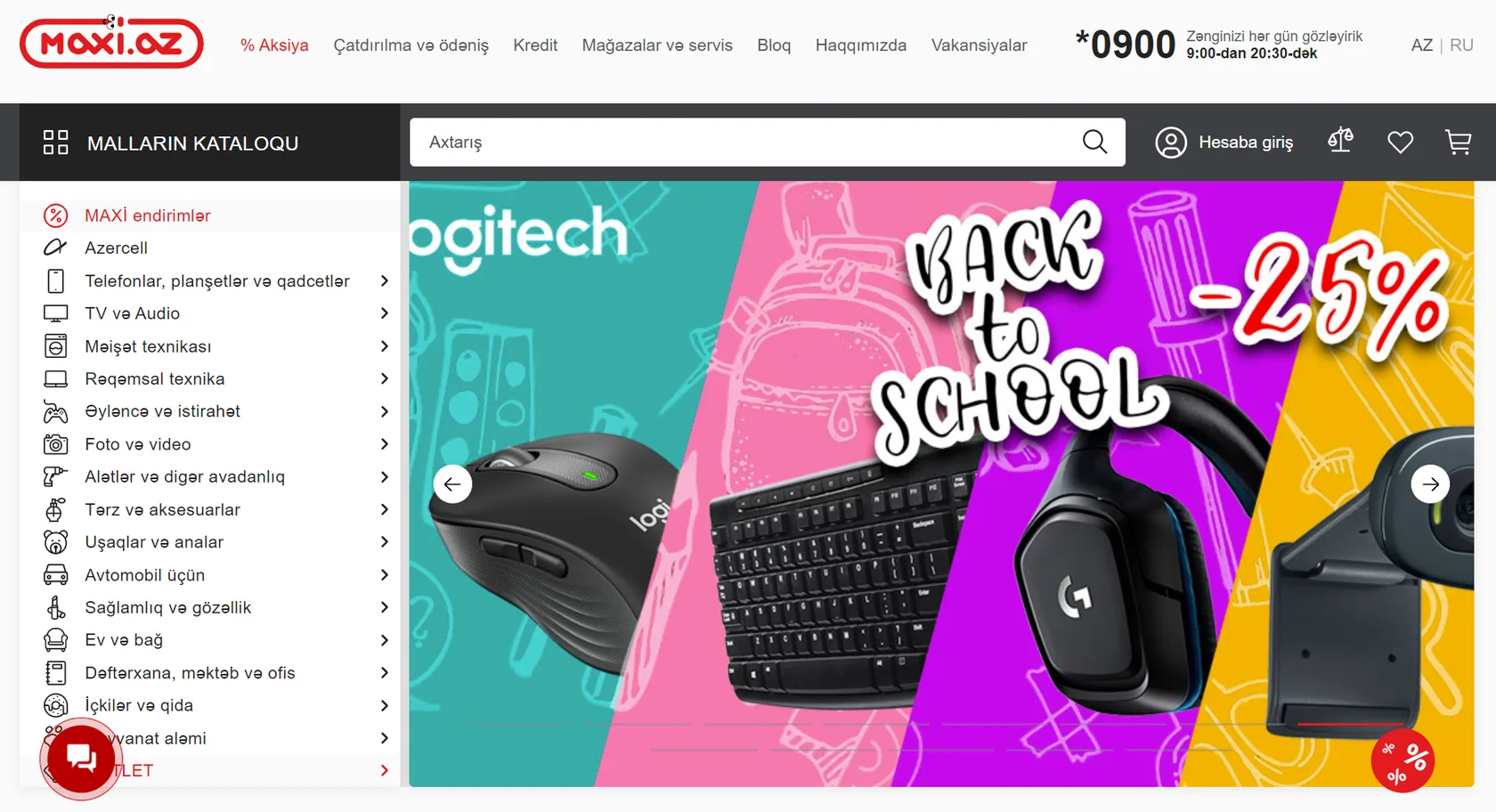
What would become a nationwide project was created in 2016 on the basis of the Integral Plus store chain. In time it became clear that the strategy had to change and that an omnichannel project was needed — and that is how Maxi.az appeared. As early as 2018 the portal was named the best online store in Azerbaijan and received the NETTY award.
According to Similar Web, the platform is among the country's top 5 online retailers across a range of metrics. This year Maxi.az is once again a contender for the title of best online store: after the site update, the company is preparing to take part in the competition.
The retailer started out mainly by selling electronics, but today the platform carries more than 11 000 products across a very wide range of categories:
- phones, tablets and gadgets;
- TVs, audio equipment, musical gear and instruments;
- home appliances;
- leisure and entertainment products;
- clothing, footwear and accessories;
- beauty and health products, and much more.
Customers can pay for an order online with every installment card available in the country — that is, credit cards with active credit lines. And delivery can be arranged anywhere in Azerbaijan: for that, Maxi.az has its own vehicle fleet and a team of couriers.
The non-trivial challenges we solved
Building the project from scratch, we completed an enormous amount of work. The team faced some genuinely complex and non-trivial challenges — here are just a few of them.
- Scaling for the future. The platform had to be built so that, over time, it could hold hundreds of thousands of products. And those products may follow completely different data models: not only technical specifications, as with electronics, but also colors and sizes — when it comes to clothing, for example.
- Regional payment specifics. Customers are able to pay with the installment cards mentioned above. The credit terms can be quite complicated, and customers may combine payment options.
- Working in marketplace mode. Maxi.az sells not only its own products but also products belonging to other owners. All of them sit in a single catalog, yet order and payment information has to be passed on to the other sellers as well.
The project was launched on a cloud service for business process automation and optimization that, among other things, includes a CRM system. So we also handled its implementation and configuration. One of the tasks was automating call handling and passing calls through to the CRM — and that is what the rest of this article is about.
Why calls are the heart of the Maxi.az business model
Calls play an important role in the company's business model. For example, a customer can always ring the sales department, and the operator will place the order for them right there during the conversation. That is why phone requests account for 50—60% of all orders.
On top of that, even when a user places an order themselves, a sales operator still contacts the customer — unless the customer has selected the "no need to call back" option.

The project's main pain point — call quality
Knowing about this specific setup, we understood from the start that IP telephony would be required. It had to distribute the load evenly between operators. And the statistics collected by a virtual PBX would let management analyze various sales department metrics.
The problem was that Maxi.az simply could not find a suitable IP telephony service. The company tried different options, but none of them met its needs. Operators complained that they could not hear the customer, and customers complained that they could not hear the operators.
How connecting Ringostat solved the problem
To improve call quality, we, as the integrators, decided to turn to Ringostat. All the more so because this platform has long had an integration with the CRM system that Maxi.az uses.
We have been working with Ringostat for about two years now. For me as an integrator it is a convenient and intuitive tool that lets you configure and automate scenarios and internal processes for different departments of a company, whatever their focus. For their staff, the single most important tool is telephony paired with the CRM. Because fast access to information is the key to a positive customer reaction. Call quality turned out to be very easy to resolve: one of Ringostat's telephony servers is located in Azerbaijan. By connecting to that server, we closed the "Customer — Operator — Server" chain of nodes within a single country. This considerably improved audio transmission quality, because a delay of even one second creates problems during a conversation.Serhii Boichuk, Head of CRM Systems at AniArt
Integrating Ringostat telephony with the CRM
Once the virtual PBX was connected, it was immediately integrated with the company's CRM system. The CRM and telephony pairing still works today with the very same settings. To quote our colleague: "Good telephony is telephony you configure once. Click — and it works."
The point of the integration is to automate the sales process, take load off the operators and even increase the chances of closing a deal successfully. Here is how the pairing works:
- during an incoming call — even one that goes unanswered — a lead and a "Call" entity are created in the CRM automatically;
- if the operator missed the call, a "Call back" task with a deadline is assigned to them.
If needed, the integration logic can easily be changed in the Ringostat account — in a dedicated matrix. It is enough to tick or untick the relevant item, guided by the tooltips.

What the operator sees before even picking up
But the most interesting part happens during an incoming call — and it is exactly what influences the chances of a successful sale. To make and receive calls, operators use Ringostat Smart Phone, an extension for the Chrome browser.
Every time a customer calls, the extension expands and shows valuable insights about the person. If it is a customer who has been in touch before and is already in the CRM, the operator immediately sees their name and can use a link in the extension to jump quickly to the contact card or to the deal.

If I were to rate the convenience of calls through Ringostat telephony from 1 to 10, it is a full 10 points. The operator has to see straight away who is calling: a regular customer or a new one. If they are a regular, you need to address them by name right from the start. That feature is one of the reasons we connected IP telephony in the first place. The customer has to feel that we remember them. Beyond that, it is very important to see the customer's history, and the CRM together with Ringostat gives us that as well. The operator can immediately look through the customer's purchase history, perhaps make an additional sale, ask about the quality or convenience of previously purchased products, and so on. In short, IP telephony is an inseparable part of any CRM system.Gorkhmaz Yunusov, Head of the Website Development Department, supervising the telephony rollout and part of the digital track
How calls are handled and operators are monitored
- Voice menu. When a customer calls the company, a voice menu starts up and plays a message offering a choice of language: Azerbaijani or Russian.
- Choosing a department. After that, the customer is offered a choice of the department they need — the online store, or the feedback and suggestions department.
- Call routing. The call is automatically routed to the department the customer selected. It rings on all operators at once — whoever picks up first takes it. That makes it possible to respond to enquiries as quickly as possible.
- Language, right away. Before even answering the call, the operator sees which language the customer chose and can address the prospective buyer in it straight away.
Maxi.az pays very close attention to suggestions and feedback. That is why the department of the same name deals only with handling them, without being distracted by order processing. Suggestions can vary widely — up to implementing particular functionality on the site. Depending on their complexity, questions may even be discussed at senior management level.
In addition, Maxi.az uses the data collected by the virtual PBX to monitor both departments and raise the quality of service.
We look at the number of answered, missed and unanswered calls per manager. We also have the ability to build reports using various parameters that act as departmental KPIs. I would separately note that Ringostat has a very good technical support team, which helped a great deal in working out the report settings and replies at any hour of the day.Gorkhmaz Yunusov, Head of the Website Development Department
Company management also listens to the call recordings made by Ringostat. This is needed to improve the quality of the operators' work and to resolve disputed situations. Particular attention is paid to how the operator responded to the customer and how they spoke with them.
Summary: what Maxi.az gained
- improved call quality;
- an automated sales department — call data goes straight into the CRM, and deals and tasks are created from calls without any manager's involvement;
- convenient receiving and placing of calls with Ringostat Smart Phone;
- a clear view of whether a new or an existing customer is calling, and the ability to address them by name right away;
- quick access to the customer card and the deal straight from Ringostat Smart Phone — thanks to which the operator better understands the customer's needs and is more likely to make the sale;
- monitoring of the operators' work through call recordings and reports that collect information on answered and missed calls.