The defining feature of Azerbaijan's e-commerce market is the dominance of a few large players. Launching an online store under such conditions is no easy task: a startup with a right to make mistakes is one thing, and a national-scale project with a matching budget — which raises the bar very high — is quite another. Mistakes at that level are simply not an option. This is the story of how we launched the online arm of the MAXI.AZ retail chain.
Integral Plus had long held a leading position in the offline market thanks to exclusive rights to sell Samsung equipment. But the dynamics of e-commerce demand constant, decisive action, and the lack of it gives competitors a free hand. So the management of Integral Plus decided to adjust its strategy and launch an omnichannel project — all the more so because the company already had a large network of offline stores with well-established marketing and considerable customer experience. That is how the MAXI.AZ brand was born.
The choice of subject for this article is no accident — this is a project of the "no room for error" class. At first glance there is nothing extraordinary about it, but on closer inspection the project's architecture reveals bold, innovative decisions built on a solid technological foundation. And the work had to push through disruptions capable of halting any development effort and putting the entire workflow at risk. Because of that, the project is an excellent illustration of the new opportunities in management and technology that open up when you solve problems of heightened complexity under a hard deadline.
The situation at the start of the project
According to the strategy approved by the holding company's management and the marketing vision of the experienced Ukrainian top manager Radyslav Filatov, MAXI.AZ's CEO, who had developed such well-known projects in Ukraine as Foxtrot and City.com, the offline and online arms of the new retail brand were to launch simultaneously.
Together with IDNT, a company specialising in retail space design, the team led by Radyslav Filatov developed the MAXI.AZ supermarket concept for the physical offline stores, while with Aniart it prepared a virtual retail space online for MAXI.AZ.
All business processes were created by the team from scratch: it was a genuine startup — a breakthrough for Azerbaijan's retail market. Ukrainian technology and expertise gave the local market a real boost. MAXI.AZ launched at the end of April and has since become one of the most recognisable and best-loved retail brands in Baku. It is worth noting that today MAXI.AZ offers not only consumer electronics and home appliances, but also all the related goods, accessories, personal transport, furniture items, consumables, coffee, tea, tableware and much more.
Strategically important decisions
From the outset Radyslav Filatov argued for choosing Ukrainian contractors, and he assembled a Ukrainian team of specialists to develop the project in Azerbaijan. Together with Yuliia Puzyrova, the marketing director, he also drew up the technical specification and ran the tender to select a platform for the online space.
Work on the online part of the MAXI.AZ project was directly supervised by Dmytro Deulin, head of MAXI.AZ's e-commerce division, who leads the online retail department team.
Everything was built from the ground up — with attention to the local mentality and the differences between product groups. We prepared the project around pickup points, signed contracts with suppliers, trained the staff, documented business processes and launched an electronic catalogue — and the result, in the opinion of industry experts, was one of the best electronics and home appliance supermarkets in the Caucasus.
Why Aniart was chosen — over to the client
All of us together chose the Aniart team without hesitation, because we already had positive experience of working with them. It is particularly gratifying when the professional status of an enterprise developer is backed up by genuinely high-level client service. It was important to us that all development follow proper standards and be well documented, and that the final project be scalable and flexible enough for further growth. Our colleagues at Aniart were able to demonstrate convincingly just how technologically mature their development process is. We made several reference calls to their current clients to get an independent opinion, and those recommendations reinforced our confidence that we had chosen the right contractor.Dmytro Deulin / head of e-commerce at MAXI
The development brief
Regional specifics of payments
Azerbaijanis commonly use taksit cards — credit cards with attached credit lines and a complex system of interest rates. We had to build a payment system that took this specific feature into account.
Scaling for the future
The project brief required us to support growth to hundreds of thousands of products. Although the MAXI brand launched only in the consumer electronics, home appliance, office equipment and photo/video segments, other sections could be added at any moment — clothing and footwear, for example, which are goods with a different inventory model (colours, sizes). The technical specification also required us to provide for the sale of services and non-standard goods without reducing performance, response time or page load speed.
Operating in marketplace mode
A marketplace is an online venue that sells both its own goods and those of third-party owners within a single catalogue, while handling checkout and passing the transaction details on to the end owner. The project called for exactly this mode of operation.
A bilingual project
Since almost 90% of the population of Azerbaijan speaks only Azerbaijani, the project launched in two languages.
Starting development and choosing the platform
Initially we planned to use a business model we had already proven: a quick start, feedback, prompt refinements, new functionality added along the way — a continuous chain of development cycles and feedback analysis.
As the development platform we chose an enterprise CMS — and we had good reasons for it.
- A ready-made component library. Our arsenal included a library of more than a hundred components refined on other projects built on this platform: proven, well-established solutions for complex marketing, business processes, large product catalogues and integration systems.
- Experience integrating with an accounting system. The client used an accounting system, and we had experience of tight integration with exactly that kind of ERP.
- A familiar interface for managers. The client's managers already had positive experience working with our platform.
- An early start on filling the catalogue. Entering the product range had to begin as quickly as possible, and the platform made it possible to populate the product catalogue long before the core functionality was ready.
Work proceeded at a brisk pace.
The unforeseen event that changed everything
But a month after the project started, something happened that fundamentally changed the plan.
At one of the meetings the client announced that the marketing department had decided to change the image of the future retail brand and had developed a new brand book, and that the launch date had been moved forward by 2 months. As a result, the project faced the threat of derailment that could have invalidated all the work already done.
By then around 30 mock-ups had been produced. The graphic design part of the project was fully complete — front-end development was about to begin.
How we responded to the sharp change of course
Once we grasped the scale of the changes, we realised we could not handle it alone. The technology side was on schedule, but creating a design from scratch for a project of this size required time we did not have.
Fortunately, we had experience of working with the SensePro team — partners we could rely on, knowing their professionalism, their sense of responsibility and their ability to truly live a project. SensePro is a company of professional designers whose track record includes such well-known projects as DON PION, Ultra.BY, "Toy samyi F.ua" and SL-IRA. Our colleagues agreed to step in and got up to speed as quickly as possible: they took charge of developing the new responsive design within the set deadline and took over all communication with the client on the visual side. On the SensePro side the work was led by Iryna Kopylova.
Consumer psychology in Azerbaijan has its own nuances — the Azerbaijani audience values convenient, modern websites just as highly as the Ukrainian one does. So Iryna decided to use the flat design concept with large interface elements — a proven design approach that had performed well on the Ukrainian market.
The active stage: two teams on one project
Given the situation, we specifically designed a business process for the interaction of three working groups.
- Prototype. The design team analysed the client's requirements, signed off the concept for each module of the project and produced a prototype.
- Checklist review. The prototype was discussed with the development team: how will it behave with different types of content? how easy is the visual solution to implement? can it be simplified, or could a different approach be applied?
- Final design. Released at three resolutions — 1366, 768, 320 (and individual blocks at 960) — so that the site would be comfortable to view on any device.
- Markup and testing. The development team built the design in markup, and a QA engineer tested cross-browser and cross-device behaviour, using dedicated software and device virtualisation for the purpose.
- Design review. The completed markup was checked against the design — in such cases a designer often finds quite a few discrepancies.
- Functionality development. The mock-ups went into development and were discussed with the client — and as a result the functionality came to life: catalogues could be filtered, products could be bought, orders could be placed.
This approach gave us an efficient production scheme: each team delivered a functionally complete module, and the team manager took on communication with the client and passed the finished result along the chain.
With this approach we got an efficient production scheme: each team delivered a functionally complete module. The manager of each team took on communication with the client and passed the finished result along the chain. We were very lucky that the client supplied quality content at an early stage of development. The client's business processes were described to us with absolute clarity, which allowed us to design the architecture precisely from the very beginning and never change it afterwards.Maya Sokolska / project manager at Aniart
We should note that the client was no less involved in the process than we were. We contacted Dmytro several times a day, submitted mock-ups for approval, exchanged proposals, received feedback and sometimes constructive criticism. And all of it was clear, fast and to the point. Often a call took place in the gaps between Dmytro's meetings and lasted no more than a minute, but the outcomes of those lightning-fast check-ins let us keep moving without losing momentum. Delay was not an option, and the client understood that as well as we did.Iryna Kopylova / project manager at Sense Production
The initial design stage determines the success of the whole project, laying its foundation. Quality communication guarantees that our requirements will be taken into account and that surprises are ruled out.Dmytro Deulin / head of e-commerce at the MAXI chain
Marketing — the key to market advantage
In competitive markets, newcomers stand a chance only with first-class marketing. The client's marketing was running at full capacity, and we had to do more than simply take that into account in the project — we had to develop full-fledged ways of delivering the client's marketing capabilities online. Which is what we did.
Solving the client's marketing challenges is our area of responsibility. I would like to comment on the most interesting of them.Iryna Kopylova / project manager, Sense Production
Taksit cards
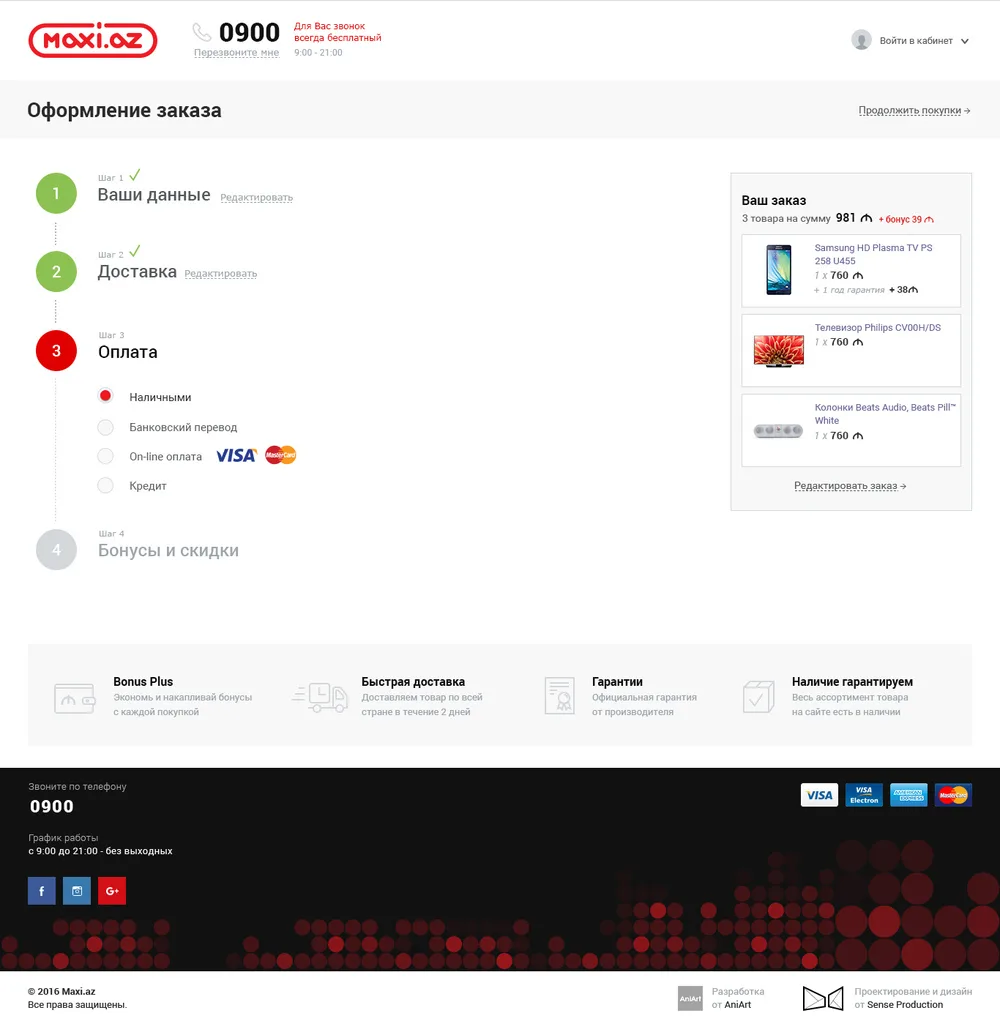
In the classic model of retail payments (and not only online), payment is accepted from a single source and with a single payment type: paying one receipt from several different bank credit or debit cards is not allowed, and neither is mixed payment — part in cash, part from a card account.
But Azerbaijan's domestic market has a feature capable of baffling any business analyst — the taksit cards mentioned earlier. When paying with such a card, the customer pays in instalments, covering a percentage of the total order amount. Interest rates differ not only between banks, but also between the retail chains where the card is used for purchases. Almost every Azerbaijani shopper has several taksit cards. In other words, by choosing the right card, a buyer can gain a noticeable benefit on the price difference when buying the very same product.
That is why in our project we implemented the ability to pay from different types of sources — this made the payment process many times more complex, adding a dozen extra checks, but it also gave rise to non-trivial yet effective marketing solutions.
On top of the price factor came the factor of complex credit terms. And if you consider that cards could be combined, we ended up with a huge range of "how to pay" options. The behaviour of a shopper making a decision with that many payment options (and combinations of those options) was described by complex decision matrices. So once the design team had produced the visual solution, it took us considerable effort to program the calculation algorithms and provide test scripts to verify them.
Bonus Plus
Connecting the bonus scheme made payment processing an order of magnitude more complex: rules for accounting for bonus points were added — earning them and using already accumulated points to partly pay for a purchase. The number of payment option combinations doubled once again.
The MAXI gift
A shopper could also receive as a gift something unrelated to the store's products — dinner for two, a cake from a patisserie and so on. This pleasant surprise was meant to strengthen the emotional bond with the brand, and it fully justified itself.
Payment with promo codes
The client made full use of every available marketing technique, so we needed to implement a promo code algorithm — discounts as a percentage or as fixed amounts for particular product groups.
MAXI discounts
Azerbaijan is very fond of all kinds of discounts and promotions — this feature of the Eastern mentality was something we could not afford to overlook.
Combined payment
As we mentioned earlier, paying for a purchase by several methods at once is widely practised on the Azerbaijani market. For example, a phone costs 215 manats (the currency of Azerbaijan), of which the customer pays in parts.
| Payment source | Amount |
|---|---|
| Cash | 100 manats |
| Taksit card | 50 manats |
| Bank card — with a choice of credit line | 65 manats |
| Total for the phone | 215 manats |
A pre-order block on the home page
There are plenty of people who want to get a long-awaited new release before everyone else. The chance to be among the first owners of the latest iPhone model, for instance, is a powerful incentive to make a purchase as soon as possible.
Specifically for such customers we implemented a "Coming soon" block that lists devices which have already been announced but are not yet on sale. Visitors can place a pre-order for these products and become their owners ahead of everyone else.
A business failure or a marketing breakthrough?
The extremely complex system for calculating the final purchase price turned into a fascinating calculator for users. Which is better — apply a coupon or redeem some bonus points? And what will the monthly rate be if all of this is put on credit? Or would it be better to add another 10 manats' worth of goods to the basket to top up the receipt total so that the volume discount kicks in, and only then take out the credit?

The client's marketers skilfully used this feature to launch a viral campaign. Information spread online about a bug in the basket algorithm, along with a list of the "secret" sequence for applying bonus points, coupons and taksit cards to obtain unprecedentedly low prices.

The tandem technology: a polymorphic product page
To load a product with as much purchase potential as possible, you need to build a landing page for it, spell out all its specifications, advantages and innovations, and illustrate it with quality content — video, audio, staged photography. This material is often taken from the manufacturers, translated and adapted. Landing pages are not the hardest work — they need only a designer and a content manager — but we were short on time.
And so we thought: what if we made every product page polymorphic? We applied this approach here for the first time within a commercial project — and it produced excellent results.
Naturally, the first products to be "landing-paged" are the sales flagships and the high-margin items. With this approach you can gradually add landing pages to the catalogue, providing unique content and good design while growing organic traffic and the time visitors spend on the site. It is a genuinely simple, effective and innovative approach — we recommend it both to newcomers to online business and to established stores. It is particularly relevant for the clothing, jewellery and high-margin product segments. Dig a little deeper and you will find here an opportunity to cut visual production costs by an order of magnitude: a budget template solution plus tandem equals a solution on the level of a custom design.
User documentation and incident handling
We did an enormous amount of work, and we can confidently state that the client is fully prepared to act in any routine or non-routine situation.
User documentation
The documentation contains instructions for the system's managers and administrators. Detailed project documentation makes it possible to turn a new employee into a team player quickly — a new developer or manager gets to grips with the details of the project in an extremely short time. The documentation is published openly with the ability to comment, ask questions and suggest improvements. The client makes active use of this, and the contractor gets rapid feedback. For our project we prepared dozens of pages of user documentation. The usage and maintenance scenarios we developed have been worked through in practice many times over.
Incident handling through ServiceDesk
Yet even with the most detailed documentation, questions still arise. They can be asked in the comments to the relevant articles, but we need the history and the coherence of the problem: it is important to record the incident, and to understand and classify the request.
- Every request can receive a link to an existing article with the solution — the user sees the material and resolves the problem.
- A request may become the reason to write a new instruction or article — this is how we learn which functionality is not yet documented.
- A request may become grounds for fixing a defect or building new functionality — in which case a development task is created.
- Once the task is resolved and the change reaches production, the request is closed automatically, the user receives a notification, and the related documentation gains a link to the time the problem was resolved along with full information on exactly what was done, by which developer, and who verified it.
We are now rolling out a global incident control system that will provide first-line support and take the load off the project managers and developers.
Information architecture and a composite site
In the meantime we were working hard on the information architecture. The solution described below may seem simple and natural, but colleagues who develop on enterprise CMS platforms will appreciate the scale of the idea and its implementation. With that in mind, here are a few technical details.

Many product groups means that the products in each group are described by their own unique set of properties. There are many product groups, new ones are added, the number of properties grows, and then another language is added, doubling the number of properties and their values. For a system designed for high loads, such an approach is critically unacceptable.
We managed to change the approach. The number of properties is fixed and equal to the number in the largest group. The very same properties hold different values depending on which group an item belongs to. Each group is described by metadata that determines which properties take part in filtering, and whether a property is a list, a range of values, a colour, a yes/no choice or simply a text description. This allowed us to obtain highly variable indexes, against which selections run as fast as possible. The number of indexes is finite, and all of them can be prepared in advance or rebuilt on the basis of usage statistics gathered under real-world conditions.
The sharding controller
Another revolutionary module, designed but never actually launched by us on this project, is the data sharding controller. With product counts in the hundreds of thousands, the number of properties grows with every new group added, and adding a new language doubles the data. In such a situation the database has to be distributed across several servers: rather than keeping a linked copy of the database, you allocate part of the data to a separate server. For example, all products, sections and related data for the electronics segment are stored on a separate server, with the same arrangement for the home appliances, building materials and other segments.
An important part of such a system is the sharding controller, which knows which server the data resides on and routes user requests to the appropriate servers in the system. This approach has limitations when it comes to simultaneous selections from several servers, but it has one undeniable advantage — an unlimited scaling resource. Horizontal sharding is used effectively in online hypermarkets — it may well be the approach our colleagues at 27.ua implemented.
An algorithm for launching a successful e-commerce platform
And finally, the signature recipe from Aniart and Sense Production: how to launch a successful e-commerce platform in a competitive market while laying a reliable foundation for future growth.
- Separate the specialisations. We honestly admit that design and UI/UX are not our specialisation: we are at our best in technology solutions, so that is what we concentrated on.
- Give the teams maximum autonomy. Teams take on all local communication with the client and deliver local results to agreed standards. This ensures production-line output.
- Take the best from the available approaches. A sensible combination of best practices results in new, successful technologies. We are confident that the tandem approach to content management that we developed will be widely used in e-commerce.
- Account for the specifics of the local market. The experience accumulated offline with credit and taksit cards is worth turning into a visual builder of the best purchase terms. A shopper should be able to use the payment instruments they are used to online as well.
- Turn risks into marketing. Any factor that could theoretically provoke a negative reaction can be turned into a marketing campaign and a tool for raising interest in the platform. By reading visitors' mood, you can successfully convert them into loyal customers.
Results
MAXI.AZ is the largest multi-brand online retailer of consumer electronics and home appliances in Azerbaijan. The creators of MAXI.AZ set themselves an ambitious goal — to become the country's best electronics and home appliance project. The MAXI.AZ chain (the retail brand was brought to market in April 2016) has its roots in and traces its history back to 2006, and in that time it has come very close to that ultimate goal, becoming one of the largest and most recognisable multichannel retailers of consumer electronics and home appliances in Azerbaijan.
Results for the client
- More than 4500 orders are placed every month.
- Site traffic has grown almost threefold.
- All the experience accumulated offline has been integrated.
- Every national characteristic of the local market has been taken into account.
- A powerful, manageable and scalable resource for developing e-commerce has been obtained.
Results for the developers
ANIART specialises in developing large e-commerce projects and ENTERPRISE solutions. Sense Production is an e-commerce agency specialising in building online stores and sales systems that take the specifics of each individual business into account.
Over the course of the project — 2 months from the first meeting to the first release, with an active development phase involving 4 people:
- Around 20 mock-ups and almost twice as many prototypes were created.
- A management technology for team interaction on complex projects was refined.
- The Sharding Controller technology module for unlimited scaling was developed.
- An innovative universal data storage module for ENTERPRISE-class projects was developed.
What comes next
Since launch the project has been building its audience and conversion is growing. Next up for us is developing and implementing an email marketing concept. The retail chain is large, with plenty of leads, contacts and buyers. There is an opportunity to use the advantages of the client's simultaneous online and offline presence and to build on the existing experience in an omnichannel environment.