Since 2010 the number of "unicorns" — startups valued at a billion — has tripled every year. We are launching a review series in which we follow the most notable projects and try to predict their fate: will this be yet another "Uber for X" or a genuine step into the future? In the first issue — four stories: Dutch grocery delivery, autism screening, freight transport automation and a local social network with utility bill payments.
Why this review
The startup market grows faster than you can keep track of it, and most loud announcements are forgotten within six months. We are interested in something else: unpacking the logic of a project — what exactly it does differently from its predecessors and why that should work. So in every issue we take a few projects and look not at the size of the round, but at the construction of the business.
Startup No. 1. Picnic: groceries from its own warehouse
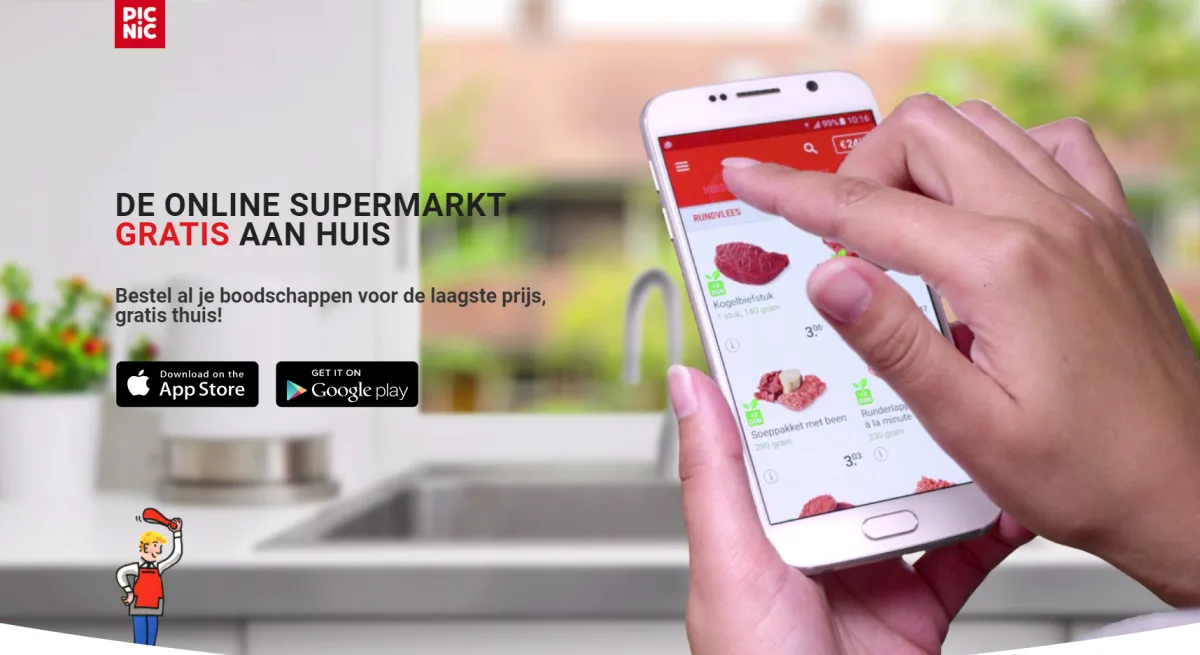
The Dutch Picnic is about buying groceries and the rest of a supermarket's basic range.

European startups rarely become trendsetters — usually they are either clones or the owners of some very narrow niche. The Dutch Picnic is trying to be an exception. The problem it solves is one of the most basic for any person, one that nobody can walk past.
Among online services worldwide there are two ways to solve this problem, and neither, broadly speaking, has become a global success.
A courier from someone else's store
Instacart and its many clones buy goods in ordinary stores and carry them to your door. This is relatively easy to organise: no need to build your own warehouses, no need to manage stock levels. But such an approach is systemically expensive — someone has to cover all of the store's costs, and then the delivery on top of that.
Your own warehouse
Utkonos and thousands of supermarkets with their own courier services. With them everything is done for real: their own wholesale suppliers, their own distribution centres, delivery going to the customer from their own warehouse with no intermediate layers.
In theory the second option should be cheaper or carry a better margin than a traditional store, since there is no unnecessary intermediate link on the product's journey. In practice, though, it seems that only the English Ocado has managed to cope with all the complexities of logistics and be profitable at large scale.
- Cheap delivery. For the own-warehouse model to be profitable and attractive to the customer, delivery has to be cheap.
- Lots of customers. For delivery to be cheap, there have to be many customers — one truck carries many orders that travel side by side.
- Lots of money for marketing. For there to be many customers, you have to spend a lot of money on advertising.
Everyone got this far in their reasoning — and this is where the giant rounds happened, which still were not enough.

Picnic, however, launched on a small territory instead of with enormous money. It is Dutch rather than Chinese to begin with, but it went not to Amsterdam but to Amersfoort with its 145 thousand residents. There the advertising budget was enough, customers became numerous, delivery trucks drove perfect routes guided by geography rather than by specific addresses, every order became one they passed anyway — and the economics added up. Customers are offered good prices, free next-day delivery with a one-hour window and a minimum order of 25 euros — an excellent offer compared with anything else, while Picnic makes a profit on every order.
Testing in Amersfoort and several smaller towns took a year and a half. After that — on the basis of a working model and the ability to enter new territories — Picnic recently raised a round for the whole of the Netherlands: 100 million euros. An all-time record.
In any case, if you look at the scale of the country, the number is enormous: converted by the ratio of GDP, for the United States it would come out at two and a half billion in startups of the usual geography. Uber ultimately raised more, but for the entire world rather than for the Netherlands, and over eight years rather than a year and a half.
Simultaneous ideas
Incidentally, simultaneous ideas are just as relevant today as they were in the days of Lomonosov and Lavoisier, who discovered one and the same law independently of each other. The visual style and colour scheme of the Picnic website echo Maxi.az — the Azerbaijani online store project we developed — to a surprising degree. Such different nations and mentalities, and such a similar vision of how to visualise their ideas.
Startup No. 2. Cognoa: screening for mental health conditions in children
The American startup Cognoa is aimed at screening for mental health conditions in children, autism first and foremost. The mechanics are as simple as can be.

- Questionnaire. One of the parents downloads the app and gets 15 questions.
- Analysis. Smart algorithms working on big data analyse the answers and return one of two verdicts: "healthy" or "slightly concerning".
- Video. In the second case Cognoa asks the parent to upload a video of the child in an ordinary setting — for further diagnosis, this time with real live doctors involved.
- Referral. And then, in the worst case, there may be a recommendation: see a specialist in person, and do it immediately.
It is hard to judge the accuracy and effectiveness of this whole process — the FDA has at least not certified this app so far. On the other hand, if false negatives are dialled down to zero and false positives are no more than 50% — and that is clearly possible — then it turns out they are reassuring half of the worried parents. Not bad at all for five minutes of questionnaire and video recording.
Access to the app is sold through the HR departments of large companies for their employees — an individual cannot buy it however much they want to. In three years of life the startup has screened around three hundred thousand children. It has raised eleven and a half million dollars in investment and wants to use that money to get through the FDA after all.
Startup No. 3. Turvo: one piece of software for everyone who moves freight
Taxis are a simple, standardised service. Making use of that simplicity, Uber and services like it achieved several different breakthroughs in it, and completely different projects can call themselves an "Uber for X".
- A marketplace of direct providers with no companies in between — an "Uber for X".
- A mobile app with a single button instead of a complicated order — an "Uber for X".
- Using unlicensed workers in a licensed activity — also an "Uber for X".
Turvo does not call itself that, but it is another variation on "Uber for commercial freight". Its idea is to automate everyone involved in transportation on a single piece of software, so that data passes between customers and providers automatically rather than by email, and so that on top of that everyone talks in a chat on one shared platform. Part of the appeal of today's taxi apps is precisely that the driver and the passenger use the same software: he pressed a button over there and the money was charged on my side right away.
In Turvo's ideal world their software would be installed by everyone in the transportation chain — from the truck driver to the logistics manager at the client company. In the end the latter would see online exactly where their cargo is, and the driver could, if needed, clarify something directly with the right person, bypassing five intermediate links. Everyone's work would go faster, everyone would earn more money, and the automators would get their share too — for their software they take an actual percentage of the value rather than a fixed subscription.
Turvo promotes itself from the top down, through customers: they are shown how convenient it will all be, and they in turn bring their contractors along the chain onto the system, so that it really does become convenient. Adoption of the service today is very thin, literally a handful of companies, but almost no money has been spent on promotion so far either — the first serious investment round, 25 million dollars, arrived a couple of months ago.
Startup No. 4. NeighBro: a local social network with utility bill payments
In every country in the world apartment owners pay enormous sums for utilities — and plenty of founders would not mind taking their commission from those payments. One such project is NeighBro, an Israeli app with Russian-speaking founders.
The startup is still early: it has raised no money, it is currently looking for a seed round, it has very few users and its revenue is almost at test level. Any big successes would have to be described in the future tense, so for now — about ideas and hypotheses.
The hook they plan to attract users with is a local social network: polls, news, simple conversation — essentially a nice-looking replacement for a messenger chat for the residents of a building. And somewhere next to the feed there is a button to pay the monthly bill: the commission is less than a percent, so why not pay in a convenient place? For now only the "maintenance" payment goes through NeighBro — a small part of the whole utilities bill, but they plan to add electricity, water and the tax as well, which is where the main sum lies in Israel.
The channel for telling residents about their potential happiness is the "vaad bayit", the Israeli equivalent of the heads of homeowners' associations in buildings and stairwells. The app partly automates their far-from-easy work — they are the accountant, the courier, the administrator and the repairs coordinator all at once — and takes nothing from them in return, so they should like it.
Another engagement tool is a certain gamification of the process.
- Five active users in a building and you receive a doormat from IKEA.
- Twenty active users and representatives of Phillips will offer a three-month bulb replacement in the stairwell and a 20% discount on their products.
In a bright future, besides a percentage of the payments, they could earn from one form of advertising or another, and in an even more distant and brighter one — enter the European and US markets. They really are looking for a seed round, so who knows, they may well find one.
What to make of all this
Four projects from different corners of the world, four completely different stages and four different ways of making money. In brief — in a single table.
| Startup | Country | What it does | Investment |
|---|---|---|---|
| Picnic | Netherlands | Buying groceries and a supermarket's basic range from its own warehouse | €100M |
| Cognoa | USA | Screening for mental health conditions in children, autism first and foremost | $11.5M |
| Turvo | USA and India | Automating everyone involved in transportation on a single piece of software | $25M |
| NeighBro | Israel | A local social network with utility bill payments | looking for seed |
Write to us with your impressions, share your opinion with our readers and send us links to the startups you would like to see in our issues. Until the next review!The ANIART editorial team
Texts based on materials from the Gornal page on Facebook.