Educational startups do not come along often — which makes it all the more interesting to look at two of them side by side. The second issue of our review features two striking projects from the USA: video lessons on the secrets of mastery taught by A-list stars, and group professional development for programmers. The subject is the same, yet the product and the business model are completely different.
Startup No. 1. MasterClass — the secrets of mastery from the stars
Video lessons on the secrets of mastery: www.masterclass.com.
What makes internet startups especially interesting is just how different projects within one and the same subject area can be. MasterClass is also about online education, but try to find anything at all in its product or business model that it shares with GeekBrains or Otus — which, incidentally, we will also be talking about in this issue.

An offer that is hard to refuse
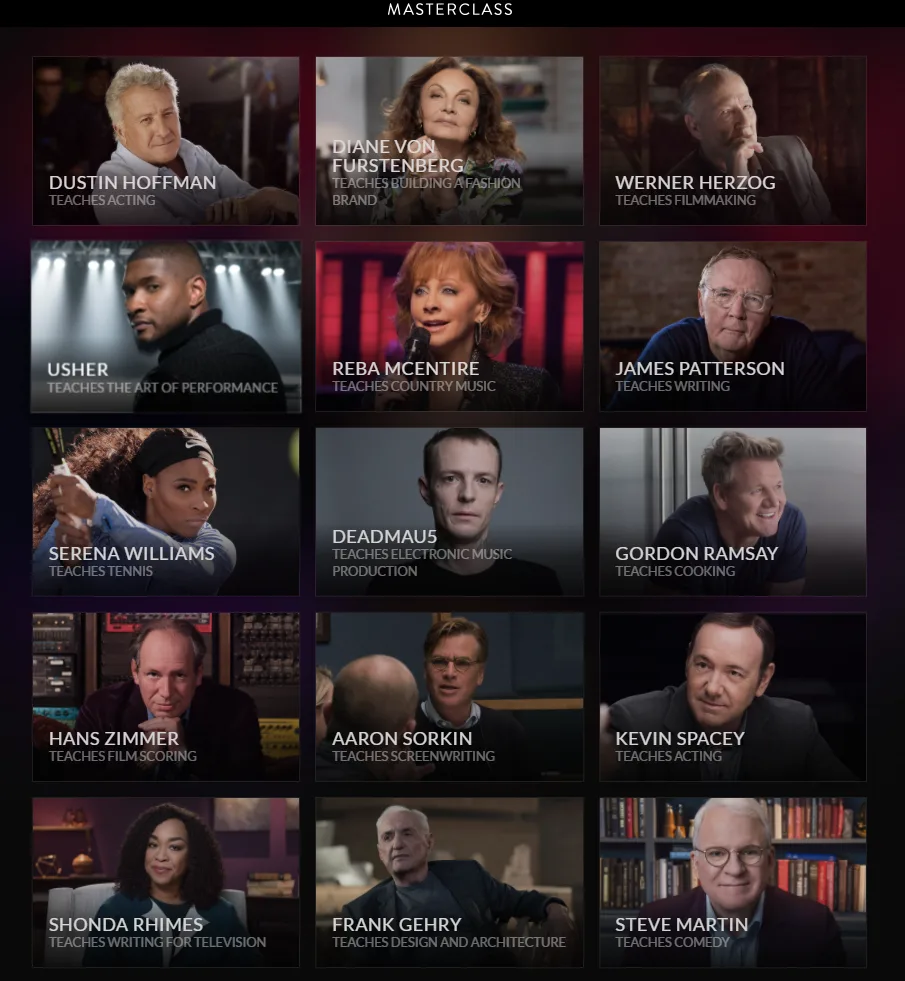
Would you like to study acting? Probably not. And would you like to study acting over the internet? Obviously not. But what if it were over the internet and taught by Dustin Hoffman? And all for $90? Now that offer sounds far more interesting, doesn't it?
That is exactly how MasterClass works: it finds A-list stars in disciplines that are not vital necessities but are pleasantly interesting to almost everyone — and records series of video lessons with them about the secrets of mastery.
- Dustin Hoffman — acting
- Serena Williams — tennis
- Christina Aguilera — singing
- Gordon Ramsay — cooking
How the learning works
Access to the lessons is sold for that same $90, part of which goes to the instructor. Besides the videos, the student gets homework assignments and peer review of that homework by fellow students.
- Buying access. The student pays for the course and unlocks the series of video lessons by the chosen star.
- Homework. The videos come with practical assignments — they have to be completed and submitted.
- Peer review. The work is reviewed by other students on the course, so feedback appears without the instructor being involved.
- Public critique. Some students get lucky — the star looks at their assignment personally, and their mistakes are discussed publicly for everyone taking the course.
Yes, in 2017 you can set and check homework even in tennis — you simply record your movements on video and then upload them to the system.
Public critique of the submitted work does two things at once: it increases the amount of content in the course, and it creates a kind of lottery-style motivation at the moment of purchase.
What if Serena herself takes a look at mine!the logic of someone buying the course

The economics of the course catalogue
Courses are added to the system slowly: right now there are just 14 of them, a year ago there were 7, and two years ago — 5.
Judging by the dynamics of the previous investment rounds, it works out that producing the videos plus the one-off fee for the star comes to somewhere around one and a half million dollars per course, and the latest round of 35 million will be enough for another 25 new topics.
Startup No. 2. Otus — professional development for programmers
Online training for developers: otus.com.
The idea behind the Otus startup — teaching programmers online in groups, through webinars and homework assignments — is, in effect, a direct counterpart to GeekBrains. The next step in this model is semi-individual volunteer mentors who help students throughout the course. Otus does not have that yet (GB does), but it will most likely appear once the scale allows for it.
The course instructor is a professional developer and an experienced teacher at the same time. That is a fairly rare combination, but it is possible to find a certain number of such people — and hundreds are not needed, at least not for the next few years.

Who the course is aimed at
Programmers come in all kinds, and they can be taught at very different levels. Out of the whole range of possible specialisations, Otus chose turning beginners into mid-level developers.
Target audience
Professionals who already earn a living through programming but are unhappy with their own level of skill and with the pay that matches it at a company outside the industry or at a weak regional studio.
Entrance test
This positioning is not just a declaration: prospective students are met at the door by a test that checks their actual knowledge. People with a zero level are kept out of the group wherever possible.
Instructor
A professional developer who is also an experienced teacher — a rare combination, but for now what is needed is a handful of such people, not hundreds.
Mentors
Semi-individual volunteers who accompany the student throughout the course are the logical next step. It is not there yet, but scale will probably make it possible.
An education project as a recruitment agency
In principle, any education project can work as a recruitment agency as well. Graduates did not study for nothing — more often than not they want to change jobs; and they were not taught for nothing — they now know something.
Employers are interested in such people and could potentially pay for the contact, while for the student it is an extra bonus that helps them decide to pay for the course. Otus does not make money on this yet, but it already promises job interviews.
The startup went public this spring; one group has been enrolled so far, the real test is still ahead, but we can already wish it success. Good luck, Otus!
Two models side by side
| Parameter | MasterClass | Otus |
|---|---|---|
| Subject | Disciplines that are not vital necessities but are pleasantly interesting to almost everyone | Programming |
| Who teaches | A-list stars in their discipline | A professional developer who is at the same time an experienced teacher |
| Format | Series of pre-recorded video lessons | Webinars and homework assignments in groups |
| Feedback | Peer review by other students, occasionally a critique from the star | Assignment review; no mentors as yet |
| Selection at the entrance | None, paying is enough | A test of actual knowledge |
| Price of access | $90 per course | Not stated in the material |
Instead of a conclusion
In closing, it is worth noting that educational startups do not come along often. Our own track record, for instance, includes a large media holding, a national carrier and a hotel operator, not to mention large-scale online stores — yet an education project is something even we cannot boast of just yet. Perhaps you are the one we have been waiting for?
Write to us with your impressions, share your opinion with our readers, and send us links to the startups you would like to see in our next issues. See you in the next review!
Texts based on material from facebook.com/gornal.