Almost everyone likes to learn — the only question is what exactly. Mastering the things you need is one thing; mastering the things you enjoy is quite another. We have already written about MasterClass, the startup where Hollywood stars help enthusiasts get better at their hobbies. This issue is devoted to startups in the same orbit — projects that move you forward in the pastimes you love: Craftsy and CreativeLive.
Startup #1. Craftsy: education in the hobby space
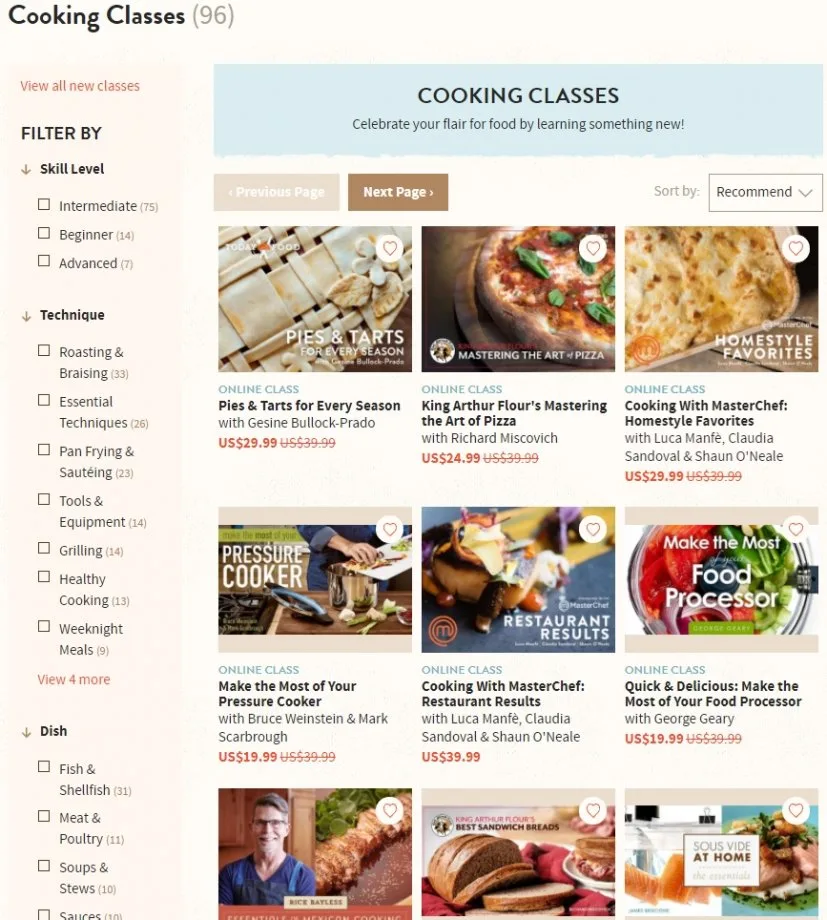
Craftsy is an educational project that helps people learn something new within their hobby: photography, cooking, sewing and so on. A typical course would be "ten secret techniques for roasting vegetables" from a chef a rung below Gordon Ramsay, but respected and easy to google.

Having bought a course, the student gets a very specific package:
- access to 6–8 videos running from 10 minutes to an hour;
- assorted supplementary materials — for cooking, that means recipe texts;
- a promise from the author of the materials to answer questions.
The main competitor is YouTube
Craftsy's main competitor is, of course, YouTube: in Russian alone there are around thirteen thousand videos on the subject of roasting vegetables.
But the advantages of a paid service are obvious — a more systematic presentation, contact with the author and the author's authority. There is a difference in substance too: YouTube is still far more often about the most popular recipe than about secret techniques.
Even so, with a huge and universally known free alternative available, prices have to be kept very low: each course costs $20–30–40, plus discounts, coupons and sales. What is more, Craftsy even promises a full refund for any reason at all, including "I just didn't like it, you're doing a bad job."
Products and a marketplace for user content

On top of the courses, Craftsy sells related physical goods — kits for cooking, sewing and the like.
In addition, exactly as on lovecrafts, it has its own marketplace of recipes and designs where users sell their UGC to one another. As on lovecrafts, no commission is charged: the service exists purely for the extra audience and its loyalty.
Craftsy's finances: the glass is half full
As for financial success, here the glass is simultaneously half full and half empty.
For an optimist, the company either reached break-even or came very close to it, and recently it was bought outright by a TV channel — excellent numbers for any startup. A pessimist will counter that there has been almost no growth in recent years, that raising $105,000,000 and selling for $230,000,000 is a mediocre ratio, and that compared with the last venture round the valuation actually fell. Both will be right.
One person's hobby is another person's work. Ideas bear fruit only in the hands of professionals. If you are heading for success — ANIART is going your way.ANIART
Startup #2. CreativeLive: on the border of hobby and self-employment
CreativeLive is in many ways similar to Craftsy. The core "product" is the same kind of video course made of a couple of dozen videos, roughly 15–20 minutes each, and even the general subject matter is comparable: hobbies, photography, art. Yet the projects are still different.

CreativeLive treats scrapbooking, photography and similar pursuits not only, and not so much, as entertainment, but rather as a mechanism for self-employment. Most courses are something along the lines of "how a photographer finds clients" or "the blog of a professional illustrator." An entire "Money & Life" section consists of materials on universally applicable work topics — from leadership to the basics of online marketing.
Shifting the emphasis shifts the price too: a purchase on CreativeLive is no longer an expense but an investment, so you can ask for more. A course costs not $20–40 but $50–100, a noticeable difference. Besides, the "business" perception of the product makes it possible to offer it to corporations: the startup is developing a B2B line and actively sells both standard off-the-shelf courses and bespoke exclusives.
| Parameter | Craftsy | CreativeLive |
|---|---|---|
| Angle | hobby for pleasure | hobby as a mechanism for self-employment |
| Course format | 6–8 videos of 10–60 minutes | a couple of dozen videos of 15–20 minutes |
| Course price | $20–40 | $50–100 |
| What else they sell | physical goods, a commission-free UGC marketplace | B2B: standard courses and bespoke exclusives |
Free broadcasts as a sales funnel
In the B2C segment, CreativeLive's know-how is free broadcasts. The mechanic is simple and works in three steps.
- An open broadcast. Several courses are always streaming on the site, and nothing stops you from learning something continuously for free.
- The limits of the format. Online is online: to get the full picture you have to be on the internet at a particular time and sit in front of the monitor for quite a while, without being distracted by entertainment or lunch.
- Meeting the lecturer. Anyone who has watched even ten minutes from the middle of a six-hour session is a potential future buyer: the lecturers talk to the audience professionally and with real enthusiasm.
Just like us. If you could look in on the work behind any of our projects, you would want to order a project from us as well. And we would deliver it.
The scale of CreativeLive
That said, the student number quoted to journalists appears to include everyone who watched the free broadcasts — and the paying audience is several times smaller. The company raised a third of that investment in this year alone.
What is worth taking from this
Price depends on what you are selling
A video course identical in format costs $20–40 when it is entertainment and $50–100 when it is an investment in self-employment.
A free alternative squeezes the price list
Thirteen thousand videos on YouTube for a single topic make it impossible to raise the price tag — you have to win on structure and the author's authority.
A refund guarantee removes the barrier
A full refund for any reason turns the purchase into an impulse buy: there is no risk for the buyer.
Free content is a funnel
Open broadcasts and a commission-free marketplace work for the audience and its loyalty, not for revenue.
Instead of a conclusion
Do you have ideas? Bring them to us, to Aniart. Our work is making your plans real, and our hobby is being glad about your successes.
Write to us with your impressions, share your thoughts with our readers and send us links to the startups you would like to see in our issues. Until the next review!
Texts based on materials from the Gornal page on Facebook.